

In

The College of the Environment
At

7.11.23
Caitlin Klask
Illustrations by Katura Reynolds
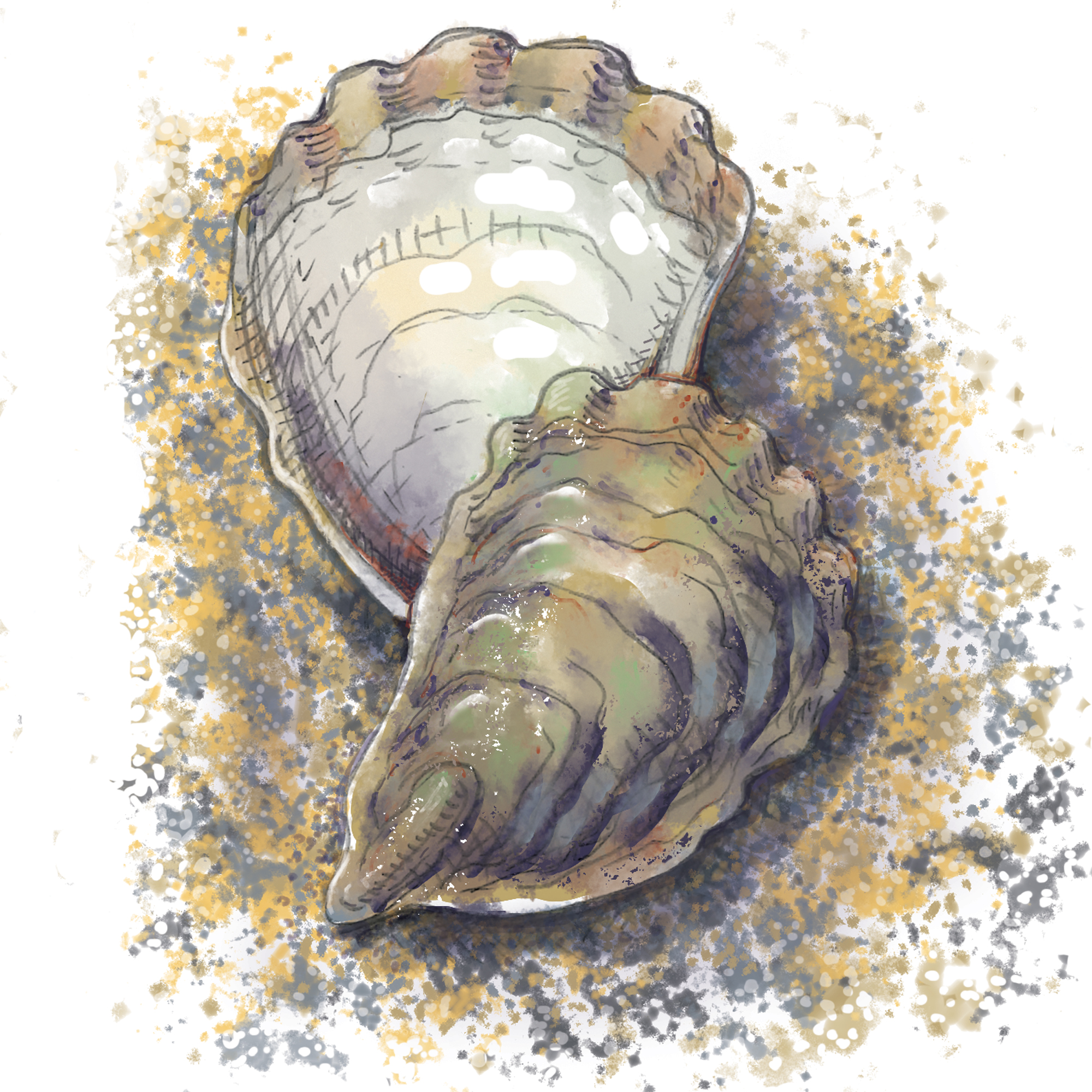
Native to the Pacific Coast of North America, the Olympia oyster is one of five species commonly farmed in Washington, along with the Pacific, Kumamoto, Shigoku and European flat oysters.
While some universities boast of their land grants, the University of Washington is where you’ll find cutting-edge research and education on sea and space.
Two teams based at the University of Washington face some of science’s most daunting challenges. Sea levels are rising, the ocean’s chemistry is changing, invasive species threaten native wildlife, and shellfish harvesters face risk to their livelihoods as heat waves and harmful algal blooms prevail. For the staff of the Washington Sea Grant program, responding to these problems is just a sample of the work they do.
Meanwhile, the team from the Washington Space Grant plans another year of rocket launches, satellite builds and high-altitude balloon research to engage students from
all over the Evergreen State as the future workforce in science, technology, engineering and math (STEM) fields—where a new generation of workers is badly needed.
In addition to their work aimed at changing the world, the teams from the Washington sea and space grant programs fill their days applying for funding, distributing scholarship and fellowship funds and reporting back to NASA and NOAA about their accomplishments. They mentor aspiring astronauts. They help coordinate tribal summits. They write books about oysters. They tweet about an eclipse. But their work, decades in the making, isn’t often front-page news.
Back in 1966, before the NOAA (National Oceanic and Atmospheric Administration) officially existed, the federal Sea Grant program was created to accompany the federal Land Grant program that was established a century earlier. In 1866, the need for working-class people to study agricultural engineering was stronger than ever, as workers shifted from fields to factories during the Industrial Revolution. In 1963, Athelstan Spilhaus (an eccentric geophysicist, meteorologist, futurist and inventor who created a device that measured temperatures at the depths of the ocean) figured it was about time to apply that same logic to the sea.
By 1968, the national Sea Grant secured federal funding. In 1970, it was incorporated into the newly official NOAA. And by 1971, the first four Sea Grant colleges were designated: Texas A&M, the University of Rhode Island, Oregon State University and the University of Washington.
Today, 34 programs—from the Pacific to the Great Lakes to the Atlantic region—contribute to Sea Grant’s research, education outreach and training programs.
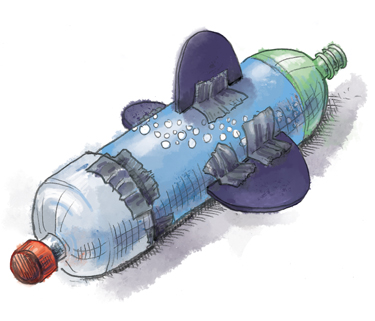
The beloved rocketry program within the Washington Space Grant provides hands-on experience to students interested in supersonic flight, from small, do-it-yourself projects (like the one pictured) to Level 1 and Level 2 certification launches. in which large, high-powered rockets soar to apogees of thousands of feet.
“Washington Sea Grant at the University of Washington is a leader in coastal research and education,” says Brooke Carney, NOAA federal program officer for Washington Sea Grant. “The University’s unique access to a variety of marine-related resources and strong relationships with area tribes allow Washington Sea Grant to work collaboratively on diverse projects that generate coastal knowledge and support local communities and Tribes.”
A shining example of that collaboration is Washington Sea Grant’s latest publication, Heaven on the Half Shell: The Story of the Oyster in the Pacific Northwest. Authors (and Washington Sea Grant former and current staff members) David George Gordon, Samantha Larson and MaryAnn Barron Wagner, ’81, revamped the book, originally published in 2001, to include new shellfish harvesting stories, particularly from the perspective of Indigenous communities and women in aquaculture, including local experts like Ed Carriere (Suquamish Tribe), Charlene Krise (Squaxin Island Tribe) and the late Kurt Grinnell (Jamestown S’Klallam Tribe). “All shellfish stories, oysters included, begin with the tribes,” says Wagner. “The second edition of the book acknowledges these first stewards and their innovations in growing seafood.”
Washington Sea Grant maintains partnerships with tribes that reaches back to the early 1970s. The team convenes the Indigenous Aquaculture Collaborative Network, which comprises Pacific-region Sea Grant offices, Northwest Tribes and First Nations, Native Hawaiian and Indigenous communities throughout the Pacific Rim. Melissa Poe, ’04, ’09, social scientist on staff at Washington Sea Grant, helps foster community-to-community knowledge exchanges to support early career Indigenous professionals and uplift the healing and restoration work led by Native communities. Recently, the group helped to rebuild an 800-year-old fish pond on Oahu in Hawai’i. They’ve also supported stone-built fishing innovations in Palau and worked in 4,000-year-old clam gardens in British Columbia—all part of a diverse complex of mariculture systems created by Indigenous people over millennia.
“Our goal at Washington Sea Grant is to make space for these dialogues,” Wagner says. “Community partners are able to reflect and form connections that nurture continued activities.”
The rich history of traditional knowledge and Indigenous aquaculture practices may reveal a path forward for the Northwest, a region battling sea-level rise, harmful algal blooms, the invasive European green crab, and even the threat of offshore drilling in southwest Washington. Looking to the past might hold a key to a sustainable future.
NASA had its hands full in 1969, including landing men on the moon. As the war in Vietnam strained the federal government’s budget, NASA saw drastic cuts in funding; meanwhile, the Apollo program had accomplished its mission, and the public was losing interest. Looking to the future of space exploration and research, NASA decided to invest $115 million in 1,400 projects at 230 universities, including $1.5 million to create the Aerospace and Engineering Research Building (AERB) at the UW.
Little did they know, Congress would go on to establish the National Space Grant College and Fellowship program in 1988. The UW would be designated as the home of the Washington Space Grant consortium, and NASA would take control of the program in 1989. By 2021, things came full circle as the Washington Space Grant relocated from the University of Washington Department of Earth & Space Sciences into the University of Washington’s Aeronautics & Astronautics program in the NASA-funded AERB, “which is kind of, if I daresay, poetic,” says Chris Wallish, communications manager.
“It wasn’t my plan to be the director of the Washington Space Grant. … the sequence of events that led to me being the director was somewhat unexpected,” says Kristi Morgansen, the principal investigator of the program and chair of the Aeronautics & Astronautics department. Former principal investigator Robert Winglee, who spent nearly 30 years at the UW researching space plasma physics, magnetospheric physics, advanced propulsion and engineering, died after a heart attack at the age of 62.
But Winglee and Morgansen shared a passion that fits perfectly into the NASA Space Grant ethos: “taking actions and providing opportunities for students in STEM to try to increase the demographics to reflect the state. And that’s something I feel very strongly about,” Morgansen says.
“NASA has daring goals, some of which are longer term. The future of NASA, aviation and space exploration will be in the hands of today’s STEM students,” says NASA’s Space Grant Project Manager Tomas Torres-Gonzalez. “The University of Washington and the Washington Space Grant Consortium are leading and supporting activities which provide a diverse population of students hands-on learning opportunities.”
From kindergarteners to doctoral researchers, students are Washington Space Grant’s top priority. “We’re really unlike a lot of other grant programs where we’re not actively engaged in research,” says Wallish. “Our whole reason for being is to support STEM students, which is usually how I start off explaining what we do, because we do a vast array of things.”
This year, the Washington Space Grant team is doubling its cohort size for the Summer Undergraduate Research Program, affectionately referred to as “SURP.” Undergrads from across Washington spend their summer in the lab doing research, which isn’t ubiquitous at the University of Washington, let alone at smaller community colleges. “We usually have about 30 to 40 students, and this year it looks like we have enough funding to [accommodate] about 80 students,” Wallish says. “It is going to be huge. A little terrifying, but exciting.”
Exciting because we need more STEM grads from all backgrounds. “Teams with a broad range of perspectives are better at problem-solving,” Morgansen says. “They come up with more innovation than teams that are all coming from the same background.”
Last summer, Morgansen dug into some data. “There are 3.3 million high school students graduating each year. And to be honest, I think maybe 10% are going into STEM. Not just four-year college degrees, but at all. And we need 40% to 50%.” It’s true that the numbers don’t look great: Only 20% of all high school graduates are prepared for college-level coursework in STEM majors. According to the U.S. Census Bureau, only 27% of STEM-educated graduates end up in a STEM job, even though the demand for such jobs is continuously growing. (Yes, that includes recent layoffs in the tech sector.)
“Not only do we need to just get more people going” into STEM fields, Morgansen says, “but if you look at the country’s demographics, that means they will necessarily have to be people of color, different racial and ethnic backgrounds. There is no other option.” Women comprise only 27% of the STEM workforce, despite making up more than 50% of college-educated workers. And according to the Educational Advisory Board, more than a third of Black (40%) and Latino (37%) students switch out of STEM majors before completing a degree.
University of Washington Space Grant staff offer students a small college atmosphere within the University of Washington’s large campus, and 92% of students who participate in their programs continue to pursue STEM after graduation. After their transition to Aeronautics & Astronautics, Morgansen took an interdisciplinary approach to sharing the small team’s large workload. Part of that is paying particular attention to students who do not get the scholarships or internships they applied for; how can they improve next time? “If you look at their background,” Morgansen says, “it’s not really any different from the ones who are getting these scholarships.
“They don’t have the mentoring. … they don’t have the support structure. In order to fix this, it’s got to be a rather fundamental change in how we’re doing things. I’m spending a lot of time in every space that I have access to, shouting this out.”
For her part, Morgansen is one of 13 (out of 52 total) directors of Space Grant consortia who is a woman. “Reaching back two decades, we have been led by someone either of a marginalized gender or a person of color,” Wallish says. The team works toward parity, having equal numbers of men and women in their program. This year, they came close with 40% women.
Both Morgansen and Wallish have ideas on how to engage the public, whether by recreating “Schoolhouse Rock” for the TikTok era or augmenting NASA’s citizen science programs, which allow people to participate virtually in scientific discoveries with just a cellphone or a laptop. Perhaps getting a taste of space will entice a future astronaut.
That’s a far tougher sell for Washington Sea Grant, given that commercial fishers, who are among their key stakeholders, participate in one of the deadliest jobs on the West Coast. According to the Bureau for Labor Statistics, commercial fishers face fatal injuries at a rate of 132.1 for every 100,000 workers in 2020. Compare those odds to an average of 3.4 fatalities in 2020 for every 100,000 workers across all jobs.
That’s where Washington Sea Grant’s Safety at Sea program comes in: Since the 1990s, they’ve trained Washington fishermen on safety equipment and skills for assessing and treating victims of crises like hypothermia, drowning and fractures. Thanks to this program, 15 lives (and an estimated $2 million in gear) have been saved.
Pacific Northwest history has also been carefully preserved by Washington Sea Grant researchers and writers. “Heaven on the Half Shell” faithfully renders the story of Washington’s favorite bivalve, the oyster.
“Oysters have this charisma that’s been going on since the gold rush in California,” says Gordon, the former Sea Grant staffer who also wrote the first version of “Heaven on the Half Shell.” “They’re symbols of wealth and success. And well, there’s kind of a sexiness to oysters that you’re not going to get from other shellfish. Manila clams, for example. Or geoducks.” They’re so appealing, in fact, that Washington is the top oyster-producing state in the country, with an industry valued at $70 million. The industry was hit hard by the Pacific Northwest’s 2021 heat wave, an event that is likely to repeat. Preserving this history could be more important than ever.
From the history of the oyster to saving lives at sea, the University of Washington Sea Grant’s team of 34 experts from all walks of marine science are ready with solutions, whether it is seaweed farming (the work of Meg Chadsey, ’98) or collaborating with Indigenous communities around shared marine resources (engagements of Poe). As the European green crab threatens Washington’s shorelines, the Sea Grant team is on the front lines removing invasive species and protecting habitats for native clams, oysters and Dungeness crab. And in the 1970s, their marine spatial planning projects helped solve a major coastal conflict.
“There’s a limited amount of space near the coast that could be used for towing vessels or for crabbers,” explains Russell Callender, former director of the University of Washington Sea Grant, who announced his retirement on April 7. “Instead of having them in conflict, we brokered an agreement that over the years allowed the crabbing community and the towboat operators to work safely and avoid conflicts.
“I think it’s amazing that it’s lasted for 50 years and it’s still ongoing. It shows the value of Washington Sea Grant being embedded in the community for a long period of time.”
The impact of these programs goes beyond the classroom. You can see it in the increasingly diversified STEM workforce, in a satellite still orbiting the Earth, in restoring Indigenous sea gardens throughout the Pacific Rim. You can even find it in the Lummi Nation’s devil’s club seeds on the International Space Station. If sea and space are at the outer reaches, Washington is ready to navigate whatever they offer.
What do the sea and space grants do?
Since the University of Washington Sea Grant and the University of Washington Space Grant teams don’t often have a classroom presence, their work might go unseen by some. Check out their core programs.
Washington Sea Grant
34 staff members along the coast
Research: The Washington Sea Grant’s partnership with NOAA allows them to sponsor research focused on coastal and marine communities, fish and fisheries, shellfish and aquaculture and ecosystem health.
Example: P. Sean McDonald, an associate teaching professor in environmental studies, is working with a team of Washington Sea Grant and UW investigators to monitor the DNA of the invasive European green crab in order to track the species.
Outreach: Teams from Washington Sea Grant help communities and workers with everything from proper boat sewage disposal to technical advice on how to prepare for sea level rise along our shorelines.
Example: Using visualizations created by the Washington Sea Grant team, Metro Parks Tacoma altered the design of Owen Beach Park to avoid erosion from rising sea levels.
Education: From fellowships to summer camps to field trips, WSG helps people learn how the ocean affects them—and how they affect the ocean.
Example: The Washington Sea Grant helped develop the Wild Seafood Exchange, a forum for fishermen, seafood buyers and restaurant operators to help fishermen boost profitability and discuss industry needs after the pandemic downturn.
Communication: Whether you’d like to get into the nitty gritty of ocean acidification or just enjoy recipes for oysters, find magazines, podcasts and more for marine-loving Washingtonians.
Example: The second edition of “Heaven on the Half Shell” is packed with history, photos, recipes, firsthand accounts from generations of oyster farmers and the cultural significance of this special mollusca.
Washington Space Grant
Two full-time staff members, plus three faculty directors
Scholarships, internships and fellowships: Both graduate and undergrad students can get professional development experience in addition to financial assistance.
Example: Space Grant Scholars earn $2,000 to $5,000 while gaining hands-on experience doing research in the lab.
CubeSat Technology Development: Students get hands-on experience by developing small satellites for space missions. Example: In 2019, a group of students launched HuskySat-1, a small satellite that has since orbited the Earth. Against all odds, HuskySat-1 transmits data back to the lab years later.
Rocketry: The Washington Space Grant team supports the UW’s robust Aeronautics & Astronautics department in a rocketry program for students interested in supersonic flight.
Example: We watched a rocket launch in the community of White Swan. Check out the video.
High-Altitude Balloons: Students can send objects up to 115,000 feet high using low-cost helium balloons.
Example: During the 2017 solar eclipse, 100 teenagers from tribes across the Pacific Northwest released balloons—each containing a “payload” of culturally significant items like feathers and wooden instruments—all the way to space and back. The balloons tracked changes in temperature and gravity during the eclipse.
See the full article here .
Comments are invited and will be appreciated, especially if the reader finds any errors which I can correct. Use “Reply”.

five-ways-keep-your-child-safe-school-shootings

Please help promote STEM in your local schools.
Stem Education Coalition

R/V Thomas G Thompson
Vision
Washington Sea Grant (WSG) envisions healthy, productive and resilient coastal and marine ecosystems that sustain Washington’s rich cultural and maritime heritage, vibrant coastal communities, clean waters and beaches, prosperous fisheries and aquaculture, diverse wildlife and an engaged public.
Mission
The WSG mission is to help people and marine life thrive by supplying research, technical expertise and educational activities that support the responsible use and conservation of ocean and coastal ecosystems.
Values
To accomplish its mission and achieve its vision, WSG adheres to a set of core values focused on excellence, equity, innovation and societal impact. It seeks to forge tools, foster insights, build capacity and maintain relationships for sustainable management, enjoyment and use of Washington’s marine resources.
WSG celebrates the diversity of people and the environment and the complex interactions between them.
Facilitating practical and collaborative solutions to today’s ocean and coastal issues, WSG serves as an unbiased broker of scientific and place-based information and real-world expertise that honors the history, people and places of Washington.
WSG endorses and is committed to pursuing activities that advance two cross-cutting principles within its core functions of research, outreach, education and communications: cultivating partnerships and practicing a commitment to diversity, equity and inclusion.
The University of Washington College of the Environment
Diversity, equity and inclusion at the Program on the Environment
How do we accomplish change that lasts, especially with complex issues such as diversity, equity and inclusion? That question lies at the heart of conversations that have been occurring over the past two years in University of Washington’s Program on the Environment (PoE). PoE is an interdisciplinary undergraduate program where students study and reflect upon intersections of the environment and human societies, and the primary unit in the College of the Environment offering a Bachelor of Arts degree. Their unit’s size (5 core faculty, 2 staff, plus several pre- and post-doctoral instructors) allows everyone in PoE to meet as a whole and to focus regularly on discussions about diversity, equity and inclusion, rather than delegating DEI work to a committee.
“One of the advantages of a small community is that we can all meet to talk about diversity initiatives at least quarterly,” said PoE Director Gary Handwerk. “The common university committee structure and bureaucracy itself can be impediments to real change.”
Some of the changes so far have included major revisions to the curriculum that introduce new course requirements in sustainability and environmental justice, and embedding and threading DEI concepts throughout all courses, deeply weaving it into the fabric of environmental awareness.
PoE also collaborated with Program on Climate Change’s Becky Alexander in creating a workshop for faculty to collaborate on integrating climate justice concepts into an array of courses across the College. These conversations among faculty from seven different units helped extend the “embed and thread” model across the College. Based on positive feedback from participants, this workshop will be offered again in winter 2022 and 2023, with participation expanded to faculty from across the University. Handwerk is “optimistic that this workshop will have long-term effects and create a framework for probing and transformative conversations across the College.”
In fall of 2021, PoE members launched an annual Autumn Seminar Series focused on Environmental Justice. Students enrolled in an associated one-credit course and participated in live sessions with speakers on Zoom, while UW and community members could tune into a livestream (later archived on the PoE YouTube page). This dual format allowed students and attendees to converse beyond the walls of a classroom and university. Enrolled students also actively participated in an online discussion forum following each presentation. This year’s series, “Indigenous Perspectives on the Environment,” brought in Indigenous voices representing a number of tribes from across the United States and Canada.
“I liked being able to hear different people’s experiences that I might not otherwise have been able to hear,” said student Tia Vontver. “The opportunity to hear from voices not through research papers or in a textbook, but directly from them was invaluable. Traditional ecological knowledge is passed down through stories, so I’ve been able to hear many different perspectives through these speakers.”
Larger challenges, however, remain. It is one thing to feature marginalized voices weekly at a seminar, and quite another to shift the demographic diversity of the faculty or student body as a whole. Handwerk acknowledges that difficult and crucial goals like these remain ahead, but he is optimistic that efforts like those described above will help to create an infrastructure and climate conducive to recruiting and retaining a robustly diverse group of faculty and students.

The University of Washington is one of the world’s preeminent public universities. Our impact on individuals, on our region, and on the world is profound — whether we are launching young people into a boundless future or confronting the grand challenges of our time through undaunted research and scholarship. Ranked number 10 in the world in Shanghai Jiao Tong University rankings and educating more than 54,000 students annually, our students and faculty work together to turn ideas into impact and in the process transform lives and our world. For more about our impact on the world, every day.
So what defines us —the students, faculty and community members at the University of Washington? Above all, it’s our belief in possibility and our unshakable optimism. It’s a connection to others, both near and far. It’s a hunger that pushes us to tackle challenges and pursue progress. It’s the conviction that together we can create a world of good. Join us on the journey.
The University of Washington is a public research university in Seattle, Washington, United States. Founded in 1861, University of Washington is one of the oldest universities on the West Coast; it was established in downtown Seattle approximately a decade after the city’s founding to aid its economic development. Today, the university’s 703-acre main Seattle campus is in the University District above the Montlake Cut, within the urban Puget Sound region of the Pacific Northwest. The university has additional campuses in Tacoma and Bothell. Overall, University of Washington encompasses over 500 buildings and over 20 million gross square footage of space, including one of the largest library systems in the world with more than 26 university libraries, as well as the UW Tower, lecture halls, art centers, museums, laboratories, stadiums, and conference centers. The university offers bachelor’s, master’s, and doctoral degrees through 140 departments in various colleges and schools, sees a total student enrollment of roughly 46,000 annually, and functions on a quarter system.
University of Washington is a member of the Association of American Universities and is classified among “R1: Doctoral Universities – Very high research activity”. According to the National Science Foundation, UW spent $1.41 billion on research and development in 2018, ranking it 5th in the nation. As the flagship institution of the six public universities in Washington state, it is known for its medical, engineering and scientific research as well as its highly competitive computer science and engineering programs. Additionally, University of Washington continues to benefit from its deep historic ties and major collaborations with numerous technology giants in the region, such as Amazon, Boeing, Nintendo, and particularly Microsoft. Paul G. Allen, Bill Gates and others spent significant time at Washington computer labs for a startup venture before founding Microsoft and other ventures. The University of Washington’s 22 varsity sports teams are also highly competitive, competing as the Huskies in the Pac-12 Conference of the NCAA Division I, representing the United States at the Olympic Games, and other major competitions.
The university has been affiliated with many notable alumni and faculty, including 21 Nobel Prize laureates and numerous Pulitzer Prize winners, Fulbright Scholars, Rhodes Scholars and Marshall Scholars.
In 1854, territorial governor Isaac Stevens recommended the establishment of a university in the Washington Territory. Prominent Seattle-area residents, including Methodist preacher Daniel Bagley, saw this as a chance to add to the city’s potential and prestige. Bagley learned of a law that allowed United States territories to sell land to raise money in support of public schools. At the time, Arthur A. Denny, one of the founders of Seattle and a member of the territorial legislature, aimed to increase the city’s importance by moving the territory’s capital from Olympia to Seattle. However, Bagley eventually convinced Denny that the establishment of a university would assist more in the development of Seattle’s economy. Two universities were initially chartered, but later the decision was repealed in favor of a single university in Lewis County provided that locally donated land was available. When no site emerged, Denny successfully petitioned the legislature to reconsider Seattle as a location in 1858.
In 1861, scouting began for an appropriate 10 acres (4 ha) site in Seattle to serve as a new university campus. Arthur and Mary Denny donated eight acres, while fellow pioneers Edward Lander, and Charlie and Mary Terry, donated two acres on Denny’s Knoll in downtown Seattle. More specifically, this tract was bounded by 4th Avenue to the west, 6th Avenue to the east, Union Street to the north, and Seneca Streets to the south.
John Pike, for whom Pike Street is named, was the university’s architect and builder. It was opened on November 4, 1861, as the Territorial University of Washington. The legislature passed articles incorporating the University, and establishing its Board of Regents in 1862. The school initially struggled, closing three times: in 1863 for low enrollment, and again in 1867 and 1876 due to funds shortage. University of Washington awarded its first graduate Clara Antoinette McCarty Wilt in 1876, with a bachelor’s degree in science.
19th century relocation
By the time Washington state entered the Union in 1889, both Seattle and the University had grown substantially. University of Washington’s total undergraduate enrollment increased from 30 to nearly 300 students, and the campus’s relative isolation in downtown Seattle faced encroaching development. A special legislative committee, headed by University of Washington graduate Edmond Meany, was created to find a new campus to better serve the growing student population and faculty. The committee eventually selected a site on the northeast of downtown Seattle called Union Bay, which was the land of the Duwamish, and the legislature appropriated funds for its purchase and construction. In 1895, the University relocated to the new campus by moving into the newly built Denny Hall. The University Regents tried and failed to sell the old campus, eventually settling with leasing the area. This would later become one of the University’s most valuable pieces of real estate in modern-day Seattle, generating millions in annual revenue with what is now called the Metropolitan Tract. The original Territorial University building was torn down in 1908, and its former site now houses the Fairmont Olympic Hotel.
The sole-surviving remnants of Washington’s first building are four 24-foot (7.3 m), white, hand-fluted cedar, Ionic columns. They were salvaged by Edmond S. Meany, one of the University’s first graduates and former head of its history department. Meany and his colleague, Dean Herbert T. Condon, dubbed the columns as “Loyalty,” “Industry,” “Faith”, and “Efficiency”, or “LIFE.” The columns now stand in the Sylvan Grove Theater.
20th century expansion
Organizers of the 1909 Alaska-Yukon-Pacific Exposition eyed the still largely undeveloped campus as a prime setting for their world’s fair. They came to an agreement with Washington’s Board of Regents that allowed them to use the campus grounds for the exposition, surrounding today’s Drumheller Fountain facing towards Mount Rainier. In exchange, organizers agreed Washington would take over the campus and its development after the fair’s conclusion. This arrangement led to a detailed site plan and several new buildings, prepared in part by John Charles Olmsted. The plan was later incorporated into the overall University of Washington campus master plan, permanently affecting the campus layout.
Both World Wars brought the military to campus, with certain facilities temporarily lent to the federal government. In spite of this, subsequent post-war periods were times of dramatic growth for the University. The period between the wars saw a significant expansion of the upper campus. Construction of the Liberal Arts Quadrangle, known to students as “The Quad,” began in 1916 and continued to 1939. The University’s architectural centerpiece, Suzzallo Library, was built in 1926 and expanded in 1935.
After World War II, further growth came with the G.I. Bill. Among the most important developments of this period was the opening of the School of Medicine in 1946, which is now consistently ranked as the top medical school in the United States. It would eventually lead to the University of Washington Medical Center, ranked by U.S. News and World Report as one of the top ten hospitals in the nation.
In 1942, all persons of Japanese ancestry in the Seattle area were forced into inland internment camps as part of Executive Order 9066 following the attack on Pearl Harbor. During this difficult time, university president Lee Paul Sieg took an active and sympathetic leadership role in advocating for and facilitating the transfer of Japanese American students to universities and colleges away from the Pacific Coast to help them avoid the mass incarceration. Nevertheless, many Japanese American students and “soon-to-be” graduates were unable to transfer successfully in the short time window or receive diplomas before being incarcerated. It was only many years later that they would be recognized for their accomplishments during the University of Washington’s Long Journey Home ceremonial event that was held in May 2008.
From 1958 to 1973, the University of Washington saw a tremendous growth in student enrollment, its faculties and operating budget, and also its prestige under the leadership of Charles Odegaard. University of Washington student enrollment had more than doubled to 34,000 as the baby boom generation came of age. However, this era was also marked by high levels of student activism, as was the case at many American universities. Much of the unrest focused around civil rights and opposition to the Vietnam War. In response to anti-Vietnam War protests by the late 1960s, the University Safety and Security Division became the University of Washington Police Department.
Odegaard instituted a vision of building a “community of scholars”, convincing the Washington State legislatures to increase investment in the University. Washington senators, such as Henry M. Jackson and Warren G. Magnuson, also used their political clout to gather research funds for the University of Washington. The results included an increase in the operating budget from $37 million in 1958 to over $400 million in 1973, solidifying University of Washington as a top recipient of federal research funds in the United States. The establishment of technology giants such as Microsoft, Boeing and Amazon in the local area also proved to be highly influential in the University of Washington’s fortunes, not only improving graduate prospects but also helping to attract millions of dollars in university and research funding through its distinguished faculty and extensive alumni network.
21st century
In 1990, the University of Washington opened its additional campuses in Bothell and Tacoma. Although originally intended for students who have already completed two years of higher education, both schools have since become four-year universities with the authority to grant degrees. The first freshman classes at these campuses started in fall 2006. Today both Bothell and Tacoma also offer a selection of master’s degree programs.
In 2012, the University began exploring plans and governmental approval to expand the main Seattle campus, including significant increases in student housing, teaching facilities for the growing student body and faculty, as well as expanded public transit options. The University of Washington light rail station was completed in March 2015, connecting Seattle’s Capitol Hill neighborhood to the University of Washington Husky Stadium within five minutes of rail travel time. It offers a previously unavailable option of transportation into and out of the campus, designed specifically to reduce dependence on private vehicles, bicycles and local King County buses.
University of Washington has been listed as a “Public Ivy” in Greene’s Guides since 2001, and is an elected member of the American Association of Universities. Among the faculty by 2012, there have been 151 members of American Association for the Advancement of Science, 68 members of the National Academy of Sciences, 67 members of the American Academy of Arts and Sciences, 53 members of the National Academy of Medicine, 29 winners of the Presidential Early Career Award for Scientists and Engineers, 21 members of the National Academy of Engineering, 15 Howard Hughes Medical Institute Investigators, 15 MacArthur Fellows, 9 winners of the Gairdner Foundation International Award, 5 winners of the National Medal of Science, 7 Nobel Prize laureates, 5 winners of Albert Lasker Award for Clinical Medical Research, 4 members of the American Philosophical Society, 2 winners of the National Book Award, 2 winners of the National Medal of Arts, 2 Pulitzer Prize winners, 1 winner of the Fields Medal, and 1 member of the National Academy of Public Administration. Among UW students by 2012, there were 136 Fulbright Scholars, 35 Rhodes Scholars, 7 Marshall Scholars and 4 Gates Cambridge Scholars. UW is recognized as a top producer of Fulbright Scholars, ranking 2nd in the US in 2017.
The Academic Ranking of World Universities (ARWU) has consistently ranked University of Washington as one of the top 20 universities worldwide every year since its first release. In 2019, University of Washington ranked 14th worldwide out of 500 by the ARWU, 26th worldwide out of 981 in the Times Higher Education World University Rankings, and 28th worldwide out of 101 in the Times World Reputation Rankings. Meanwhile, QS World University Rankings ranked it 68th worldwide, out of over 900.
U.S. News & World Report ranked University of Washington 8th out of nearly 1,500 universities worldwide for 2021, with University of Washington’s undergraduate program tied for 58th among 389 national universities in the U.S. and tied for 19th among 209 public universities.
In 2019, it ranked 10th among the universities around the world by SCImago Institutions Rankings. In 2017, the Leiden Ranking, which focuses on science and the impact of scientific publications among the world’s 500 major universities, ranked University of Washington 12th globally and 5th in the U.S.
In 2019, Kiplinger Magazine’s review of “top college values” named University of Washington 5th for in-state students and 10th for out-of-state students among U.S. public colleges, and 84th overall out of 500 schools. In the Washington Monthly National University Rankings University of Washington was ranked 15th domestically in 2018, based on its contribution to the public good as measured by social mobility, research, and promoting public service.
 sciencesprings