

From The Skolkovo Institute of Science and Technology [Сколковский институт науки и технологий] (RU)
7.14.23
Skoltech Communications
+7 (495) 280 14 81
communications@skoltech.ru
Scientists at the University of Graz, in collaboration with researchers from Skoltech, have achieved a breakthrough in solar physics by utilizing artificial intelligence to simulate the magnetic field in the upper atmosphere of the Sun in quasi real-time. This groundbreaking research, published in Nature Astronomy [below], holds immense promise for advancing our understanding of the Sun’s behavior and its impact on space weather.
The solar magnetic field is the main driver of space weather, which can cause damage to critical infrastructures like electricity, aviation, and our space-based technology.

The main source of severe space weather events are solar active regions, which are regions around sunspots where strong magnetic fields emerge through the solar surface. Current observing capabilities only allow us to measure the magnetic field at the surface of the Sun, however, the energy buildup and release happens higher up in the solar atmosphere, the Sun’s corona.

By leveraging the capabilities of physics-informed neural networks, the team successfully managed to integrate observational data with the physical force-free magnetic field model, providing a comprehensive understanding of the connection between the observed phenomena and the underlying physics that governs the Sun’s activity. This cutting-edge method marks a significant milestone in solar physics and opens up new opportunities for numerical simulations of the Sun.
The researchers simulated the evolution of an observed solar active region and demonstrated the ability to perform force-free magnetic field simulations in real-time. Impressively, this process only required less than 12 hours of computation time to simulate an observation series of five days. This unprecedented speed enables scientists to conduct real-time analysis and forecasts of solar activity, enhancing our ability to predict space weather events.
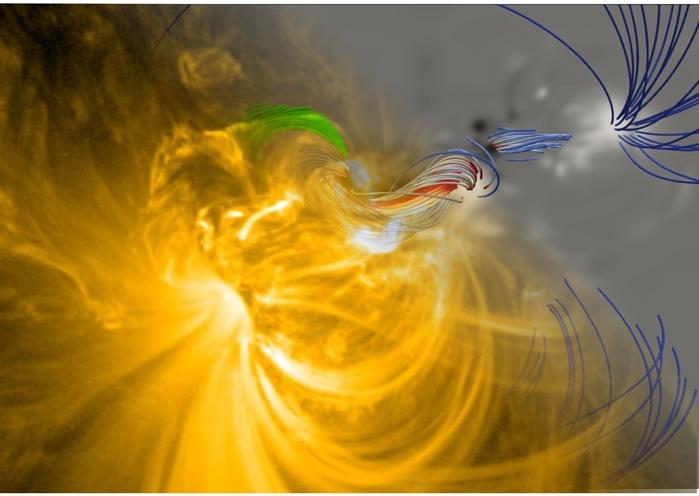
Composite of extreme ultraviolet observation (left) and magnetic field (right). The magnetic field lines are obtained from the simulation and show agreement with the outlined structures in EUV (from Jarolim et. al, 2023)
The team further studied the time evolution of free magnetic energy within the coronal volume, which is linked to solar eruptive events on the Sun like coronal mass ejections — large plasma clouds ejected from the atmosphere of the Sun at speeds of 100-3,500 km/s.


The comparison to extreme ultraviolet observations confirmed the robustness and accuracy of the methodology. Crucially, the results revealed significant depletions of free magnetic energy, both spatially and temporally, which directly correlate with observed solar eruptions.
Robert Jarolim, the lead researcher, commented about the implications of this breakthrough: “Our use of artificial intelligence in this context represents a transformative leap forward. The use of AI techniques for numerical simulations allows us to better incorporate observational data and holds great potential to further advance our simulation capabilities.” Skoltech Associate Professor Tatiana Podlachikova highlights, “The computing speed holds significant promise for improving space weather forecasting and advancing our knowledge of the Sun’s behavior.”
This research conducted by the scientists at the University of Graz and Skoltech represents a remarkable advancement in the field of solar physics. By harnessing the power of AI and physics-informed neural networks, they have achieved real-time simulations of the solar coronal magnetic field, revolutionizing our ability to comprehend solar activity.
The study was developed with the support of Skoltech’s high-performance cluster Zhores for the anticipated Solar Physics Research Integrated Network Group (SPRING) that will provide autonomous monitoring of the Sun using cutting-edge technology of observational solar physics. SPRING is pursued within the SOLARNET project, which is dedicated to the European Solar Telescope initiative supported by the E.U. research and innovation funding program Horizon 2020.

 European Solar Telescope to be located at Teide Observatory [Observatorio del Teide] in the Canary Islands (ES).
See the full article here.
Comments are invited and will be appreciated, especially if the reader finds any errors which I can correct. Use “Reply”.

five-ways-keep-your-child-safe-school-shootings
Please help promote STEM in your local schools.

The Skolkovo Institute of Science and Technology [Сколковский институт науки и технологий] (RU) is a private institute located in Moscow, Russia. Skoltech was established in 2011 as part of a multi-year partnership with the Massachusetts Institute of Technology.
As an academic institution, Skoltech primary mission is academic excellence in target domains. This includes performing cutting-edge basic and applied research and educating next generation of science, technology and business leaders.
Also, as a leading academic institution, Skoltech generates value in a form of professional education, advisory services, industry-funded research and results implementation, services of shared facilities, technology licensing and new companies established by the Institute’s scholars, engineers, students and alumni. Therefore, Skoltech reinforces Russia’s technology excellence in target domains and bridges the gap between research and industry.
Skoltech forms a part of the Skolkovo community which creates a new, self-sustaining innovation ecosystem providing an engine for Russian high-tech industry and attracting foreign investments. In this paradigm, Skoltech acts as a catalyst to foster cutting-edge research in advanced areas of crucial importance for Russia, promote entrepreneurial activity and train internationally competitive specialists capable of working in a rapidly changing research and technology landscape.
 sciencesprings