From Ethan Siegel: “Top 10 Facts About The Big Bang Theory”

Starts with a Bang

May 5, 2016
Ethan Siegel

Inflationary Universe. NASA/WMAP

NASA/WMAP
NASA/WMAP

Universe map Sloan Digital Sky Survey (SDSS) 2dF Galaxy Redshift Survey
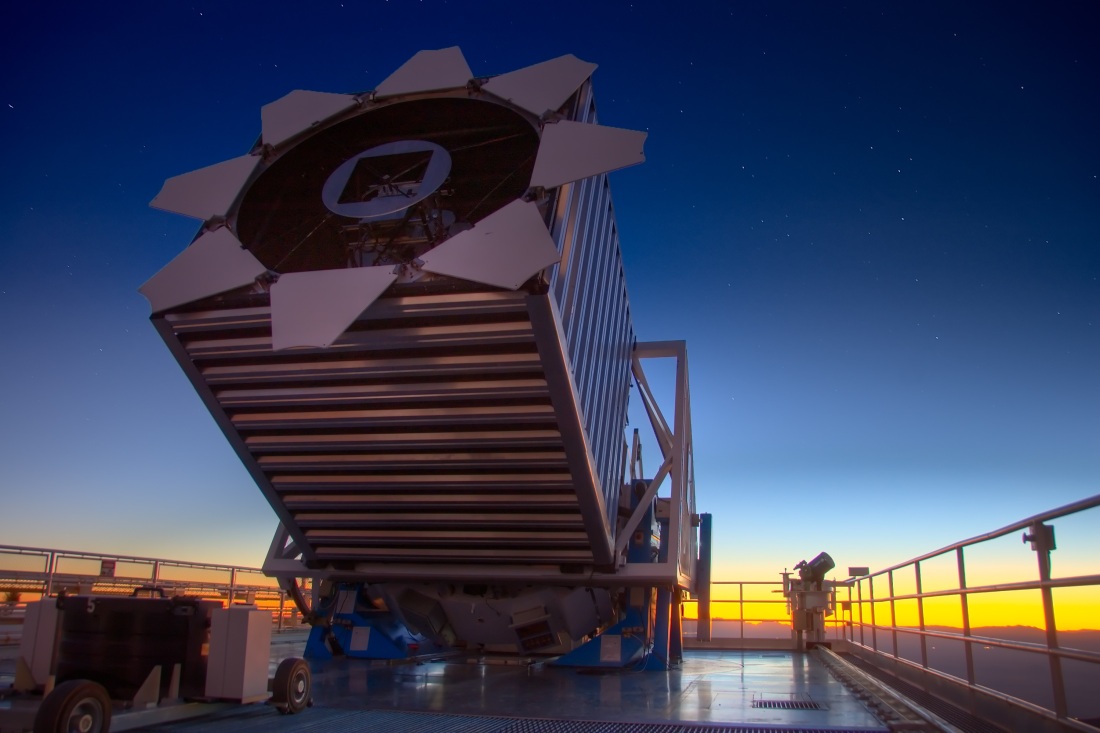

SDSS Telescope at Apache Point, NM, USA

If you ask a scientist where the Universe got its start, “the Big Bang” is the answer you’re most likely to get. Our Universe full of stars, galaxies and a cosmic web of large-scale structure, all separated by the vastness of empty space between them, wasn’t born that way and didn’t exist that way forever. Instead, the Universe came to be this way because it expanded and cooled from a hot, dense, uniform, matter-and-radiation-filled state with no galaxies, stars, or even atoms present at the start. Everything that exists in its current form today didn’t exist 13.8 billion years ago, and all of this was figured out during the past 100 years. But even with all this, there are a whole slew of facts most people — even many scientists — don’t quite get about it. Here are our top 10 facts about the Big Bang!

1
Images credit: New York Times, 10 November 1919 (L); Illustrated London News, 22 November 1919 (R)

1.) Einstein first dismissed it outright when it was presented to him as a possibility. Einstein’s general theory of relativity was a revolutionary theory of gravity, proposed in 1915, as a successor to Newton’s theory. It predicted the orbital motion of Mercury to an accuracy Newton’s theory couldn’t, it predicted the bending of starlight by mass confirmed in 1919…

Radio galaxies gravitationally lensed by a very large foreground galaxy cluster Hubble

…and it predicted the existence of gravitational waves, just confirmed a few months ago.

Caltech/MIT Advanced aLigo detector in Livingston, Louisiana

Gravitational waves. Credit: MPI for Gravitational Physics/W.Benger-Zib

But it also predicted that a Universe that was full of matter and static, or unchanging over time, would be unstable.

3
Georges Lemaître at the Catholic University of Leuven, ca. 1933. Public domain image.

When the Belgian priest and scientist Georges Lemaître, in 1927, put forth the idea that the spacetime fabric of the Universe could be very large and expanding, having emerged from a smaller, denser, more uniform state in the past, Einstein wrote back to him, “Vos calculs sont corrects, mais votre physique est abominable,” which means “ your calculations are correct, but your physics is abominable!”

2
Image credit: Robert P. Kirshner, PNAS, via http://www.pnas.org/content/101/1/8/F3.expansion. The red box indicates the extent of Hubble’s original data.

2.) Hubble’s discovery of the expanding Universe turned it into a serious idea. Although many scientists considered that the spiral nebulae in the sky were distant galaxies all on their own even before Einstein, it was Edwin Hubble’s work in the 1920s that showed this was not only true, but that the more distant a galaxy was, the faster it was receding away from us. This fact — Hubble’s Law, describing the expansion of the Universe — led to a very straightforward interpretation consistent with the Big Bang idea: if the Universe is expanding today, then it was smaller and denser in the past!

3.) The idea had been around since 1922, but was widely dismissed for decades. Soviet Physicist Alexandr Friedmann came up with the theory for it in 1922, when it was criticized by Einstein. Lemaître’s 1927 work was also dismissed by Einstein, and even after Hubble’s work in 1929, the idea that the Universe was smaller, denser, and more uniform in the past was only a fringe idea. But Lemaître added in the idea that the redshift of galaxies could be explained by this expansion of space, and that there must have been an initial “moment of creation” at the beginning, which was known as either the “primeval atom” or the “cosmic egg” for decades.

Into what is the universe expanding NASA Goddard
Into what is the universe expanding NASA Goddard, Dana Berry.

4.) The theory rose to true prominence in the 1940s when it made a startling set of predictions. George Gamow, an American scientist who became enamored of Lemaître’s ideas, realized that if the Universe was expanding today, then the wavelength of the light in it was increasing over time, and therefore the Universe was cooling. If it’s cooling today, then it must have been hotter in the past. Extrapolating backwards, he recognized that there once was a time period where it was too hot for neutral atoms to form, and then a period before that where it was too hot for even atomic nuclei to forms. Therefore, as the Universe expanded and cooled, it must have formed the light elements and then neutral atoms for the first time, resulting in the existence of a “primeval fireball,” or a cosmic background of cold radiation just a few degrees above absolute zero.

5
Fred Hoyle presenting a radio series, The Nature of the Universe, in 1950. Image credit: BBC.

5.) The name “Big Bang” came about from the theory’s most fervent detractor, Fred Hoyle. A theory making a different set of predictions — the Steady-State Theory of the Universe — was actually the leading theory of the Universe in the 1940s, 1950s and into the 1960s, as the claim that the vast majority of the atoms came from stars that died and not this early, hot dense state was borne out by nuclear physics. Hoyle, speaking to the BBC, coined the term in a 1949 radio interview, saying, “One [idea] was that the Universe started its life a finite time ago in a single huge explosion, and that the present expansion is a relic of the violence of this explosion. This big bang idea seemed to me to be unsatisfactory even before detailed examination showed that it leads to serious difficulties.”

Big Ear, Arno Penzias and Robert Wilson, AT&T, Holmdel, NJ USA

6.) The 1964 discovery of the leftover glow from the Big Bang was initially thought to be from bird poop. In 1964, scientists Arno Penzias and Bob Wilson, working at the Holmdel Horn Antenna at Bell Labs, discovered a uniform radio signal coming from everywhere in the sky at once. Not realizing it was the Big Bang’s leftover glow, they thought it was a problem with the antenna, and tried to calibrate this “noise” away. When that didn’t work, they went into the antenna and discovered nests of pigeons living in there! They cleaned the nests (and droppings) of the pigeons out of there, and yet the signal remained. The realization that it was the discovery of Gamow’s prediction vindicated the Big Bang model, entrenching it as the scientific origin of our Universe. It also makes Penzias and Wilson the only Nobel-winning scientists to clean up animal poop as part of their Nobel-worthy research.

7.) The confirmation of the Big Bang gives us an explicit history for the formation of stars, galaxies, and rocky planets in the Universe. If the Universe started off hot, dense, expanding and uniform, then not only would we cool and form atomic nuclei and neutral atoms, but it would take time for gravitation to pull objects together into gravitationally collapsed structures. The first stars would take 50-to-100 million years to form; the first galaxies wouldn’t form for 150-250 million years; Milky Way-sized galaxies might take billions of years and the first rocky planets wouldn’t form until multiple generations of stars lived, burned through their fuel, and died in catastrophic supernovae explosions. It may not be a coincidence that we’re observing the Universe now, 13.8 billion years after the Big Bang; it might be that this is when the time is ripe for life on rocky worlds to emerge!

Cosmic Microwave Background per ESA/Planck

ESA/Planck
ESA/Planck

8.) The fluctuations in the cosmic microwave background tell us how close-to-perfectly uniform the Universe was at the start of the Big Bang. The cosmic microwave background is just 2.725 K today, but the fluctuations shown above are only around ~100 microKelvin in magnitude. The fact that the leftover glow from the Big Bang has slight non-uniformities of a particular magnitude at that early time tells us that the Universe was uniform to 1-part-in-30,000, but the fluctuations are what give rise to all the structure — stars, galaxies, etc. — that we see in the Universe today.

History of the universe, National Science Foundation, E Siegel
National Science Foundation (NASA, JPL, Keck Foundation, Moore Foundation, related) — Funded BICEP2 Program; modifications by E. Siegel.

9.) The Big Bang itself doesn’t necessarily mean the very beginning anymore. It’s tempting to extrapolate this hot, dense expanding state all the way back to a singularity, as Lemaître did some 89 years ago. But there’s a suite of observations — led by the fluctuations in the primeval fireball — that teach us there was a different state prior to that, where all the energy in the Universe was inherent to space itself, and that space expanded at an exponential rate. This period was known as cosmic inflation, and we’re still researching the details on that. Science progresses farther and farther back, but so far, there’s no end in sight.

3
Image credit: NASA & ESA, of possible models of the expanding Universe.

10.) And the way the Universe began doesn’t tell us the way it will end. Finally, the Big Bang tells us there was a race between gravity, trying to recollapse the expanding Universe, and the initial expansion, trying to drive everything apart. But the Big Bang on its own doesn’t tell us what the fate will be; that takes knowing what the entire Universe is made out of. With the existence of dark energy, discovered just 18 years ago, we’ve learned that not only will the expansion win, but that the most distant galaxies will continue to speed up in their recession from us. Our cold, lonely, empty fate is what we get in a dark energy Universe, but if the Universe were born with just a tiny bit more matter or radiation than what we have today, our fate could’ve been very different!

See the full article here .

Please help promote STEM in your local schools.

STEM Icon

Stem Education Coalition

“Starts With A Bang! is a blog/video blog about cosmology, physics, astronomy, and anything else I find interesting enough to write about. I am a firm believer that the highest good in life is learning, and the greatest evil is willful ignorance. The goal of everything on this site is to help inform you about our world, how we came to be here, and to understand how it all works. As I write these pages for you, I hope to not only explain to you what we know, think, and believe, but how we know it, and why we draw the conclusions we do. It is my hope that you find this interesting, informative, and accessible,” says Ethan

From Rochester: “Are we alone? Setting some limits to our uniqueness”

U Rochester bloc

University of Rochester

April 26, 2016
Leonor Sierra

Are humans unique and alone in the vast universe? This question–summed up in the famous Drake equation–has for a half-century been one of the most intractable and uncertain in science.

But a new paper shows that the recent discoveries of exoplanets combined with a broader approach to the question makes it possible to assign a new empirically valid probability to whether any other advanced technological civilizations have ever existed.

And it shows that unless the odds of advanced life evolving on a habitable planet are astonishingly low, then human kind is not the universe’s first technological, or advanced, civilization.

The paper*, published in Astrobiology, also shows for the first time just what “pessimism” or “optimism” mean when it comes to estimating the likelihood of advanced extraterrestrial life.

“The question of whether advanced civilizations exist elsewhere in the universe has always been vexed with three large uncertainties in the Drake equation,” said Adam Frank, professor of physics and astronomy at the University of Rochester and co-author of the paper. “We’ve known for a long time approximately how many stars exist. We didn’t know how many of those stars had planets that could potentially harbor life, how often life might evolve and lead to intelligent beings, and how long any civilizations might last before becoming extinct.”

__________________________________________________________________________________________________

Select A Region:
Our local neighborhood in the galaxy (a cube with sides of 1,000ly)
Milky Way galaxy
Observable Universe
Select A Probability:
10-24 (About as likely that you’d be hit by lightning four times in one year)
10-18 (About one in a billion billion)
3 x 10⁻⁹ (About as likely you will win the powerball)
10-4 (About one in 10,000)
INTERACTIVE: Life on other planets? What are the odds?

How likely is it that we are the first advanced civilization? Use this graphic to find out.

Choose a cosmic “neighborhood” to play in: just our own local corner, the whole Milky Way, or the whole observable universe
Choose your probability factor: how optimistic or pessimistic are you that advanced life can evolve on other habitable planets?

__________________________________________________________________________________________________

“Thanks to NASA’s Kepler satellite and other searches, we now know that roughly one-fifth of stars have planets in “habitable zones,” where temperatures could support life as we know it.

NASA/Kepler Telescope

So one of the three big uncertainties has now been constrained.”

Frank said that the third big question–how long civilizations might survive–is still completely unknown. “The fact that humans have had rudimentary technology for roughly ten thousand years doesn’t really tell us if other societies would last that long or perhaps much longer,” he explained.

But Frank and his coauthor, Woodruff Sullivan of the astronomy department and astrobiology program at the University of Washington, found they could eliminate that term altogether by simply expanding the question.

“Rather than asking how many civilizations may exist now, we ask ‘Are we the only technological species that has ever arisen?” said Sullivan. “This shifted focus eliminates the uncertainty of the civilization lifetime question and allows us to address what we call the ‘cosmic archaeological question’—how often in the history of the universe has life evolved to an advanced state?”

That still leaves huge uncertainties in calculating the probability for advanced life to evolve on habitable planets. It’s here that Frank and Sullivan flip the question around. Rather than guessing at the odds of advanced life developing, they calculate the odds against it occurring in order for humanity to be the only advanced civilization in the entire history of the observable universe. With that, Frank and Sullivan then calculated the line between a Universe where humanity has been the sole experiment in civilization and one where others have come before us.

“Of course, we have no idea how likely it is that an intelligent technological species will evolve on a given habitable planet,” says Frank. But using our method we can tell exactly how low that probability would have to be for us to be the ONLY civilization the Universe has produced. We call that the pessimism line. If the actual probability is greater than the pessimism line, then a technological species and civilization has likely happened before.”

Using this approach, Frank and Sullivan calculate how unlikely advanced life must be if there has never been another example among the universe’s ten billion trillion stars, or even among our own Milky Way galaxy’s hundred billion.

The result? By applying the new exoplanet data to the universe’s 2 x 10 to the 22nd power stars, Frank and Sullivan find that human civilization is likely to be unique in the cosmos only if the odds of a civilization developing on a habitable planet are less than about one in 10 billion trillion, or one part in 10 to the 22th power.

“One in 10 billion trillion is incredibly small,” says Frank. “To me, this implies that other intelligent, technology producing species very likely have evolved before us. Think of it this way. Before our result you’d be considered a pessimist if you imagined the probability of evolving a civilization on a habitable planet were, say, one in a trillion. But even that guess, one chance in a trillion, implies that what has happened here on Earth with humanity has in fact happened about a 10 billion other times over cosmic history!”

For smaller volumes the numbers are less extreme. For example, another technological species likely has evolved on a habitable planet in our own Milky Way galaxy if the odds against it evolving on any one habitable planet are better than one chance in 60 billion.

But if those numbers seem to give ammunition to the “optimists” about the existence of alien civilizations, Sullivan points out that the full Drake equation—which calculates the odds that other civilizations are around today—may give solace to the pessimists.

2

In 1961, astrophysicist Frank Drake developed an equation to estimate the number of advanced civilizations likely to exist in the Milky Way galaxy. The Drake equation (top row) has proven to be a durable framework for research, and space technology has advanced scientists’ knowledge of several variables. But it is impossible to do anything more than guess at variables such as L, the probably longevity of other advanced civilizations.

In new research, Adam Frank and Woodruff Sullivan offer a new equation (bottom row) to address a slightly different question: What is the number of advanced civilizations likely to have developed over the history of the observable universe? Frank and Sullivan’s equation draws on Drake’s, but eliminates the need for L.

Their argument hinges upon the recent discovery of how many planets exist and how many of those lie in what scientists call the “habitable zone” – planets in which liquid water, and therefore life, could exist. This allows Frank and Sullivan to define a number they call Nast. Nast is the product of N*, the total number of stars; fp, the fraction of those stars that form planets; and np, the average number of those planets in the habitable zones of their stars.

They then set out what they call the “Archaelogical-form” of the Drake equation, which defines A as the “number of technological species that have ever formed over the history of the observable Universe.”

Their equation, A=Nast*fbt, describes A as the product of Nast – the number of habitable planets in a given volume of the Universe – multiplied by fbt – the likelihood of a technological species arising on one of these planets. The volume considered could be, for example, the entire Universe, or just our Galaxy.

“The universe is more than 13 billion years old,” said Sullivan. “That means that even if there have been a thousand civilizations in our own galaxy, if they live only as long as we have been around—roughly ten thousand years—then all of them are likely already extinct. And others won’t evolve until we are long gone. For us to have much chance of success in finding another “contemporary” active technological civilization, on average they must last much longer than our present lifetime.”

“Given the vast distances between stars and the fixed speed of light we might never really be able to have a conversation with another civilization anyway,” said Frank. “If they were 20,000 light years away then every exchange would take 40,000 years to go back and forth.”

But, as Frank and Sullivan point out, even if there aren’t other civilizations in our galaxy to communicate with now, the new result still has a profound scientific and philosophical importance. “From a fundamental perspective the question is ‘has it ever happened anywhere before?’” said Frank. Our result is the first time anyone has been able to set any empirical answer for that question and it is astonishingly likely that we are not the only time and place that an advance civilization has evolved.”

According to Frank and Sullivan their result has a practical application as well. As humanity faces its crisis in sustainability and climate change we can wonder if other civilization-building species on other planets have gone through a similar bottleneck and made it to the other side. As Frank puts it “We don’t even know if it’s possible to have a high-tech civilization that lasts more than a few centuries.” With Frank and Sullivan’s new result, scientists can begin using everything they know about planets and climate to begin modeling the interactions of an energy-intensive species with their home world knowing that a large sample of such cases has already existed in the cosmos. “Our results imply that our evolution has not been unique and has probably happened many times before. The other cases are likely to include many energy intensive civilizations dealing with their feedbacks onto their planets as their civilizations grow. That means we can begin exploring the problem using simulations to get a sense of what leads to long lived civilizations and what doesn’t.”

*Science paper:
A New Empirical Constraint on the Prevalence of Technological Species in the Universe

See the full article here .

Please help promote STEM in your local schools.

STEM Icon

Stem Education Coalition

U Rochester Campus

The University of Rochester is one of the country’s top-tier research universities. Our 158 buildings house more than 200 academic majors, more than 2,000 faculty and instructional staff, and some 10,500 students—approximately half of whom are women.

Learning at the University of Rochester is also on a very personal scale. Rochester remains one of the smallest and most collegiate among top research universities, with smaller classes, a low 10:1 student to teacher ratio, and increased interactions with faculty.

From The New York Times: "Stalking the Shadow Universe"

New York Times

JULY 16, 2014
DENNIS OVERBYE

For centuries people have found meaning — or thought they did — in what they could see in the sky, the shapes of the constellations echoing old myths, the sudden feathery intrusion of comets, the regular dances of the planets, the chains of galaxies, spanning unfathomable distances of time and space.

Universe

Since the 1980s, however, astronomers have been forced to confront the possibility that most of the universe is invisible, and that all the glittering chains of galaxies are no more substantial, no more reliable guides to physical reality, than greasepaint on the face of a clown.

The brute mathematical truth is that atoms, the stuff of stars, you and me, make up only 5 percent of the universe by weight. A quarter of it is made of mysterious particles known as dark matter, and the remaining 70 percent a mysterious form of energy called dark energy. Physicists theorize that dark matter could be exotic particles left over from the Big Bang. They don’t know what it is, but they can deduce that dark matter is there by its gravitational effect on the things they can see. If [Isaac] Newton’s laws of gravity held over cosmic distances, huge amounts of more matter than we can see were needed to provide the gravitational glue to keep clusters of galaxies from flying apart, and to keep the stars swirling around in galaxies at high speed.

Cosmologists have theorized that it is in fact dark matter, slowly congealing under its own weight into vast clouds, that provides the scaffolding for stars and galaxies.

To strip the greasepaint from cosmic history, astronomers have performed computer simulations of how dark matter would evolve from a nearly uniform cloud into the filaments and clumps characteristic of the arrangement of galaxies today in the luminous universe. A multinational group led by Mark Vogelsberger of the Massachusetts Institute of Technology has recently performed one of the most detailed of these studies yet, a calculation called Illustris.

Their model sought to take into account not just the gravity of dark matter particles pulling atoms and one another around, but the electromagnetic and nuclear interactions between atoms — so-called gastrophysics — like the formation and explosion of stars.

The result, they said, is the closest match yet between dark matter models and the distribution and types of galaxies in the visible universe.

Meanwhile, astronomers at the California Institute of Technology have begun to be able to illuminate and map the weblike structure of the dark matter in space using an instrument they call the Cosmic Web Imager on the 200-inch telescope at Palomar Observatory. The imager in effect uses bright galaxies and quasars as a kind of flashlight to light up the sparse atoms strewn along with the dark matter in space, confirming the tendril structure predicted by the computer simulations.

Caltech Cosmic Web Imager
Cosmic Web Imager

Caltech Palomar Observatory
Palomar Observatory – Caltech

qua
Quasar

More evidence of the power of the dark side.


ScienceSprings is powered by MAINGEAR computers