From U Washington: “UW Medical Center ready to deploy tiniest pacemaker ever”

U Washington

University of Washington

05.20.2016
Brian Donohue

1
The old and the new: a conventional pacemaker, left, and the Medtronic Micra are displayed by UW Medicine electrophysiologists Jordan Prutkin and Kristen Patton.

The world’s smallest pacemaker will debut soon at UW Medical Center – one of two Washington state hospitals that will offer the device for the next several months.

Drs. Jordan Prutkin and Kristen Patton, cardiac electrophysiologists with the UW Medicine Regional Heart Center, received final training this week from representatives of Medtronic, the manufacturer of the device, named Micra.

About as tall and wide as a AAA battery, the device is threaded up through the femoral vein to the heart, where it is attached to the right ventricle to deliver impuses when a patient’s heartbeat is too slow. The unit’s direct placement takes advantage of another advance: Its battery is inside, so there are no wires connected to a separate power source.

For decades, pacemakers have comprised a generator, usually implanted under the skin in the patient’s left chest, and leads, which carry impulses from the generator into the heart. The wires are these devices’ main vulnerability, wearing out over time and heightening risk of infections. Removing broken leads years after implant can be problematic because they often have become enmeshed within the tissue of blood vessels.

“That’s why this miniature technology is so important and transformative – because it really does reduce risks associated with these devices,” Patton said.

On April 6, the U.S. Food and Drug Administration approved the Micra for patients with slow or irregular heart rhythms. The FDA based its decision on a clinical trial of 719 patients implanted with the device. In the study, 98 percent of patients experienced adequate heart pacing and fewer than 7 percent had complications such as blood clots, heart injury and device dislocation.

The risk of dislodgement is low, Patton said. “Its tiny hooks deploy straight into the muscle and grab and it is very hard to detach.”

The Micra will have limited applicability, at least initially, because it paces only one chamber. About 75 percent of conventional pacemakers pace at least two of the heart’s chambers.

“This is good for people who only need pacing in the ventricle because they have atrial fibrillation in the top chamber, and for people who only need pacing a small percentage of the time,” Prutkin said.

2
Illustration of the Micra being deployed into a right ventricle. Medtronic

Similar to other single-chamber devices on the market, the Micra’s battery is projected to last 10 to 14 years, depending on how much pacing a patient requires.

At the Micra training, Patton said, she heard something that she hadn’t expected.

“The two physicians leading the session have a lot of experience with this device, and they said it makes a difference psychologically to patients; it removes the visible bump under the skin of the generator and that persistent reminder that ‘something is wrong with my heart.’

“We hear from patients all the time, wondering whether they should move less to protect against lead fracture. Patients ask, ‘What if I wear a backpack? Can I still do pushups or play golf?’ This device seems to be a positive step in that way,” Patton said.

Prutkin sees this device as the beginning of the next generation of pacemakers.

“Right now this can only go in the ventricle, but in time this will be available for both the atria and ventricles, and multiple devices in one person will be able to talk to one another to regulate a heartbeat. That’s down the road, but that’s where this technology is heading.”

The device also will be available at Sacred Heart Medical Center in Spokane.

See the full article here .

Please help promote STEM in your local schools.

STEM Icon

Stem Education Coalition

The University of Washington is one of the world’s preeminent public universities. Our impact on individuals, on our region, and on the world is profound — whether we are launching young people into a boundless future or confronting the grand challenges of our time through undaunted research and scholarship. Ranked number 10 in the world in Shanghai Jiao Tong University rankings and educating more than 54,000 students annually, our students and faculty work together to turn ideas into impact and in the process transform lives and our world. For more about our impact on the world, every day.

So what defines us — the students, faculty and community members at the University of Washington? Above all, it’s our belief in possibility and our unshakable optimism. It’s a connection to others, both near and far. It’s a hunger that pushes us to tackle challenges and pursue progress. It’s the conviction that together we can create a world of good. Join us on the journey.

From U Washington: “UW researchers unleash graphene ‘tiger’ for more efficient optoelectronics”

U Washington

University of Washington

May 13, 2016
James Urton

1
Image of one of the graphene-based devices Xu and colleagues worked with.Lei Wang

In the quest to harvest light for electronics, the focal point is the moment when photons — light particles — encounter electrons, those negatively-charged subatomic particles that form the basis of our modern electronic lives. If conditions are right when electrons and photons meet, an exchange of energy can occur. Maximizing that transfer of energy is the key to making efficient light-captured energetics possible.

“This is the ideal, but finding high efficiency is very difficult,” said University of Washington physics doctoral student Sanfeng Wu. “Researchers have been looking for materials that will let them do this — one way is to make each absorbed photon transfer all of its energy to many electrons, instead of just one electron in traditional devices.”

In traditional light-harvesting methods, energy from one photon only excites one electron or none depending on the absorber’s energy gap, transferring just a small portion of light energy into electricity. The remaining energy is lost as heat. But in a paper* released May 13 in Science Advances, Wu, UW associate professor Xiaodong Xu and colleagues at four other institutions describe one promising approach to coax photons into stimulating multiple electrons. Their method exploits some surprising quantum-level interactions to give one photon multiple potential electron partners. Wu and Xu, who has appointments in the UW’s Department of Materials Science & Engineering and the Department of Physics, made this surprising discovery using graphene.

“Graphene is a substance with many exciting properties,” said Wu, the paper’s lead author. “For our purposes, it shows a very efficient interaction with light.”

Graphene is a two-dimensional hexagonal lattice of carbon atoms bonded to one another, and electrons are able to move easily within graphene. The researchers took a single layer of graphene — just one sheet of carbon atoms thick — and sandwiched it between two thin layers of a material called boron-nitride.

“Boron-nitride has a lattice structure that is very similar to graphene, but has very different chemical properties,” said Wu. “Electrons do not flow easily within boron-nitride; it essentially acts as an insulator.”

Xu and Wu discovered that when the graphene layer’s lattice is aligned with the layers of boron-nitride, a type of “superlattice” is created with properties allowing efficient optoelectronics that researchers had sought. These properties rely on quantum mechanics, the occasionally baffling rules that govern interactions between all known particles of matter. Wu and Xu detected unique quantum regions within the superlattice known as Van Hove singularities.

2
The Moiré superlattice they created by aligning graphene and boron-nitride. Sanfeng Wu

“These are regions of huge electron density of states, and they were not accessed in either the graphene or boron-nitride alone,” said Wu. “We only created these high electron density regions in an accessible way when both layers were aligned together.”

When Xu and Wu directed energetic photons toward the superlattice, they discovered that those Van Hove singularities were sites where one energized photon could transfer its energy to multiple electrons that are subsequently collected by electrodes— not just one electron or none with the remaining energy lost as heat. By a conservative estimate, Xu and Wu report that within this superlattice one photon could “kick” as many as five electrons to flow as current.

With the discovery of collecting multiple electrons upon the absorption of one photon, researchers may be able to create highly efficient devices that could harvest light with a large energy profit. Future work would need to uncover how to organize the excited electrons into electrical current for optimizing the energy-converting efficiency and remove some of the more cumbersome properties of their superlattice, such as the need for a magnetic field. But they believe this efficient process between photons and electrons represents major progress.

“Graphene is a tiger with great potential for optoelectronics, but locked in a cage,” said Wu. “The singularities in this superlattice are a key to unlocking that cage and releasing graphene’s potential for light harvesting application.”

Co-authors were Lei Wang, Xian Zhang, Cory Dean and James Hone at Columbia University; You Lai and Zhiqiang Li at the National High Magnetic Field Laboratory in Florida; Wen-Yu Shan and Di Xiao at Carnegie Mellon University; former UW graduate student Grant Aivazian; and Takashi Taniguchi and Kenji Watanabe at the National Institute for Materials Science in Japan. The work at the UW was funded by the National Science Foundation and the U.S. Air Force Office of Scientific Research. Xu acknowledges the support from the Boeing Distinguished Professorship and Washington’s state-funded Clean Energy Institute.

*Science paper:
Multiple hot-carrier collection in photo-excited graphene Moiré superlattices

See the full article here .

Please help promote STEM in your local schools.

STEM Icon

Stem Education Coalition

The University of Washington is one of the world’s preeminent public universities. Our impact on individuals, on our region, and on the world is profound — whether we are launching young people into a boundless future or confronting the grand challenges of our time through undaunted research and scholarship. Ranked number 10 in the world in Shanghai Jiao Tong University rankings and educating more than 54,000 students annually, our students and faculty work together to turn ideas into impact and in the process transform lives and our world. For more about our impact on the world, every day.

So what defines us — the students, faculty and community members at the University of Washington? Above all, it’s our belief in possibility and our unshakable optimism. It’s a connection to others, both near and far. It’s a hunger that pushes us to tackle challenges and pursue progress. It’s the conviction that together we can create a world of good. Join us on the journey.

From U Washington: “Early Earth’s air weighed less than half of today’s atmosphere”

U Washington

University of Washington

May 9, 2016
Hannah Hickey

The idea that the young Earth had a thicker atmosphere turns out to be wrong. New research from the University of Washington uses bubbles trapped in 2.7 billion-year-old rocks to show that air at that time exerted at most half the pressure of today’s atmosphere.

1
The layers on this 2.7 billion-year-old rock, a stromatolite from Western Australia, show evidence of single-celled, photosynthetic life on the shore of a large lake. The new result suggests that this microbial life thrived despite a thin atmosphere.Roger Buick/University of Washington

The results, published* online May 9 in Nature Geoscience, reverse the commonly accepted idea that the early Earth had a thicker atmosphere to compensate for weaker sunlight. The finding also has implications for which gases were in that atmosphere, and how biology and climate worked on the early planet.

“For the longest time, people have been thinking the atmospheric pressure might have been higher back then, because the sun was fainter,” said lead author Sanjoy Som, who did the work as part of his UW doctorate in Earth and space sciences. “Our result is the opposite of what we were expecting.”

The idea of using bubbles trapped in cooling lava as a “paleobarometer” to determine the weight of air in our planet’s youth occurred decades ago to co-author Roger Buick, a UW professor of Earth and space sciences. Others had used the technique to measure the elevation of lavas a few million years old. To flip the idea and measure air pressure farther back in time, researchers needed a site where truly ancient lava had undisputedly formed at sea level.

Their field site in Western Australia was discovered by co-author Tim Blake of the University of Western Australia. There, the Beasley River has exposed 2.7 billion-year-old basalt lava. The lowest lava flow has “lava toes” that burrow into glassy shards, proving that molten lava plunged into seawater. The team drilled into the overlying lava flows to examine the size of the bubbles.

A stream of molten rock that forms a lava quickly cools from top and bottom, and bubbles trapped at the bottom are smaller than those at the top. The size difference records the air pressure pushing down on the lava as it cooled, 2.7 billion years ago.

2
One of the lava flows analyzed in the study, from the shore of Australia’s Beasley River. Gas bubbles that formed as the lava cooled, 2.7 billion years ago, have since filled with calcite and other minerals. The bubbles now look like white spots. Researchers compared bubble sizes from the top and bottom of the lava flows to measure the ancient air pressure.Sanjoy Som/University of Washington

Rough measurements in the field suggested a surprisingly lightweight atmosphere. More rigorous x-ray scans from several lava flows confirmed the result: The bubbles indicate that the atmospheric pressure at that time was less than half of today’s.

Earth 2.7 billion years ago was home only to single-celled microbes, sunlight was about one-fifth weaker, and the atmosphere contained no oxygen. But this finding points to conditions being even more otherworldly than previously thought. A lighter atmosphere could affect wind strength and other climate patterns, and would even alter the boiling point of liquids.

“We’re still coming to grips with the magnitude of this,” Buick said. “It’s going to take us a while to digest all the possible consequences.”

Other geological evidence clearly shows liquid water on Earth at that time, so the early atmosphere must have contained more heat-trapping greenhouse gases, like methane and carbon dioxide, and less nitrogen.

The new study is an advance on the UW team’s previous work on “fossilized raindrops” that first cast doubt on the idea of a far thicker ancient atmosphere. The result also reinforces Buick’s 2015 finding that microbes were pulling nitrogen out of Earth’s atmosphere some 3 billion years ago.

“The levels of nitrogen gas have varied through Earth’s history, at least in Earth’s early history, in ways that people just haven’t even thought of before,” said co-author David Catling, a UW professor of Earth and space sciences. “People will need to rewrite the textbooks.”

The researchers will next look for other suitable rocks to confirm the findings and learn how atmospheric pressure might have varied through time.

While clues to the early Earth are scarce, it is still easier to study than planets outside our solar system, so this will help understand possible conditions and life on other planets where atmospheres might be thin and oxygen-free, like that of the early Earth.

Som is CEO of Seattle-based Blue Marble Space, a nonprofit that focuses on interdisciplinary space science research, international awareness, science education and public outreach. He currently does astrobiology research at NASA’s Ames Research Center in California.

The research was funded by NASA. Other co-authors are former UW undergraduate student John Perreault, now at the University of Alaska Fairbanks; former UW graduate student Jelte Harnmeijer, now at Scotland’s James Hutton Institute; and James Hagadorn, curator of geology at the Denver Museum of Nature & Science.

*Science paper:
Earth’s air pressure 2.7 billion years ago constrained to less than half of modern levels

See the full article here .

Please help promote STEM in your local schools.

STEM Icon

Stem Education Coalition

The University of Washington is one of the world’s preeminent public universities. Our impact on individuals, on our region, and on the world is profound — whether we are launching young people into a boundless future or confronting the grand challenges of our time through undaunted research and scholarship. Ranked number 10 in the world in Shanghai Jiao Tong University rankings and educating more than 54,000 students annually, our students and faculty work together to turn ideas into impact and in the process transform lives and our world. For more about our impact on the world, every day.

So what defines us — the students, faculty and community members at the University of Washington? Above all, it’s our belief in possibility and our unshakable optimism. It’s a connection to others, both near and far. It’s a hunger that pushes us to tackle challenges and pursue progress. It’s the conviction that together we can create a world of good. Join us on the journey.

From U Washington: “Tracking ‘marine heatwaves’ since 1950 – and how the ‘blob’ stacks up”

U Washington

University of Washington

March 30, 2016
Hannah Hickey

Unusually warm oceans can have widespread effects on marine ecosystems. Warm patches off the Pacific Northwest from 2013 to 2015, and a couple of years earlier in the Atlantic Ocean, affected everything from sea lions to fish migrations to coastal weather.

A University of Washington oceanographer is lead author of a study looking at the history of such features across the Northern Hemisphere. The study was published in March in the journal Geophysical Research Letters.

1
The “warm blob” off the Pacific Northwest coast in April 2014, as shown in the July 2014 newsletter where it got its evocative name. The new study shows this feature was most prominent through the end of 2014, though it persisted into 2015.NOAA

“We can think of marine heatwaves as the analog to atmospheric heatwaves, except they happen at the sea surface and affect marine ecosystems,” said lead author Hillary Scannell, a UW doctoral student in oceanography. “There are a lot of similarities.”

Land-based heatwaves are becoming more frequent and more intense due to climate change. Scannell and her collaborators’ work suggests this may also be happening in the north Atlantic and Pacific oceans. Their study finds that marine heatwaves have recurred regularly in the past, but have become more common since the 1970s, as global warming has become more pronounced.

The new paper looks at the frequency of marine heatwaves in the North Atlantic and the North Pacific since 1950. Scannell did the work as a master’s student at the University of Maine, where she was inspired by the 2012 record-breaking warm waters off New England.

“After that big warming event of 2012 we keyed into it and wanted to know how unusual it was,” Scannell said. The study also analyzes another recent event, the so-called “warm blob” that emerged in 2013 and 2014 off the Pacific Northwest.

The authors analyzed 65 years of ocean surface temperatures, from 1950 to 2014, and also looked at how these two recent events stack up.

In general, the results show that the larger, more intense and longer-lasting a marine heatwave is, the less frequently it will occur. The study also shows that the two recent events were similar to others seen in the historical record, but got pushed into new territory by the overall warming of the surface oceans.

An event like the northwest Atlantic Ocean marine heatwave, in which an area about the size of the U.S. stayed 2.0 degrees Fahrenheit (1.1 C) above normal for three months, is likely to naturally occur about every five years in the North Atlantic and northwestern Pacific oceans, and more frequently in the northeast Pacific.

The “blob” in the northeast Pacific covered an even larger area, with surface temperatures 2.7 degrees Fahrenheit (1.5 C) above normal for 17 months, and is expected from the record to naturally happen about once every five years off the West Coast.

In the northeast Pacific, the record shows that marine heatwaves are more likely during an El Niño year and when the Pacific Decadal Oscillation brings warmer temperatures off the west coast of North America. So the 2013-15 “blob” likely got an extra kick from a possible transition to the favorable phase of the Pacific Decadal Oscillation, as well as from the overall warming of the ocean.

“The blob was an unfortunate but excellent example of these events,” Scannell said. “As we go into the uncharted waters of a warming climate, we may expect a greater frequency of these marine heatwaves.”

Scannell is also co-author of an earlier study published in February in which the authors define the term “marine heatwave” and specify the duration, temperature change and spatial extent that would meet their criteria. That study was led by researchers in Australia, who were curious about a warm event from 2010 to 2011 in the Indian Ocean.

“We’re working towards a more streamlined definition so we can more easily compare these events when they occur in the future,” Scannell said.

Better understanding of marine heatwaves could help prepare ocean ecosystems and maritime industries. At the UW, Scannell currently works with Michael McPhaden, a UW affiliate professor of oceanography and scientist at the National Oceanic and Atmospheric Administration, looking at air-sea interactions along the equator and other factors that might create marine heatwaves.

Co-authors on the new paper are Andrew Pershing and Katherine Mills at the Gulf of Maine Research Institute, Michael Alexander at the National Oceanic and Atmospheric Administration in Boulder and Andrew Thomas at the University of Maine. The study was funded by the National Science Foundation.

See the full article here .

Please help promote STEM in your local schools.

STEM Icon

Stem Education Coalition

The University of Washington is one of the world’s preeminent public universities. Our impact on individuals, on our region, and on the world is profound — whether we are launching young people into a boundless future or confronting the grand challenges of our time through undaunted research and scholarship. Ranked number 10 in the world in Shanghai Jiao Tong University rankings and educating more than 54,000 students annually, our students and faculty work together to turn ideas into impact and in the process transform lives and our world. For more about our impact on the world, every day.

So what defines us — the students, faculty and community members at the University of Washington? Above all, it’s our belief in possibility and our unshakable optimism. It’s a connection to others, both near and far. It’s a hunger that pushes us to tackle challenges and pursue progress. It’s the conviction that together we can create a world of good. Join us on the journey.

From U Washington: “Stem cell research gets undergrads out of classroom”

U Washington

University of Washington

03.23.2016
McKenna Princing

1
Deepkiran Singh, a UW junior in biochemistry, demonstrates pipetting, a lab technique to measure or transfer liquids.

UW undergraduate Randy Lu grasps a pair of tweezers in each hand. His fingers making imperceptible movements as he dissects the tiny abdomen of a fruit fly. The tweezers and Lu’s hands look garishly large next to the insect, which is a mere speck in a glass dish. Lu has to look through a microscope in order to see it in detail.

Leaning over Lu’s shoulders is his mentor and fellow undergraduate Debra Del Castillo, who guides him as he learns how to master the light touch necessary to complete such delicate work. Lu is not the first student Del Castillo has mentored: As program coordinator for an undergraduate research project that brings students into the lab of UW biochemistry professor, Hannele Ruohola-Baker at UW Medicine’s Institute for Stem Cell and Regenerative Medicine Research. Del Castillo has overseen the work of dozens of students for the past two years.

The students contribute to an ongoing study examining a protective signal daughter cells send back to their stem cells in the germ line of fruit flies. The signal seems to help the stem cells survive even when they are targeted with chemotherapy or radiation. Researchers believe this phenomenon could explain why some cancers are so difficult to eradicate.

To combat this, researchers are screening nearly 1,600 different molecules to see if any prevent the daughter cells from sending that signal. Molecules that do this could be turned into a drug that would prevent tumors from regenerating.

The screen is an intensive process composed of multiple steps—a perfect opportunity, Del Castillo feels, to teach undergraduates how real-world science often works.

2
Debra Del Castillo looks through a confocal microscope to check undergraduate Randy Lu’s progress dissecting flies. McKenna Princing

“Most undergraduate programs have labs where the experiments are highly optimized, where you know what the results are going to be,” she said.

Ruohola-Baker testified to the explorative nature of the work students partake in.

“You are the first one in the world to find the answer for your question when you come in the morning to develop that film, study those stem cells in the confocal microscope or analyze their level of RNA after the drug treatment,” she said. “Your job is to go to the edge of human knowledge and push beyond.”

The step-by-step process looks like this: Students feed one of the small molecules in question to a days-old fruit fly, then sacrifice the insect, isolate the affected cells and put them through a lengthy immunohistochemistry protocol. Next come dissection and analysis to determine whether or not the molecule interfered with the protective signal. Students are usually trained for three to four months before they are allowed to complete the process on their own and analyze results.

“I have to work with them a lot to get the confidence to make that call, because they’re young and they’ve never done this before, and they’re afraid they’ve done it wrong,” Del Castillo said.

She, too, had to develop confidence when she first joined the project. Currently a post-baccalaureate studying biochemistry, she took a winding path to get where she is now: A degree and then a job in engineering, followed by many years of caregiving, first for her children and then for her aunt, who was diagnosed with Huntington’s disease.

“It all ended at once; I went from caregiving to nothing, so I thought I’d go back to school,” she said. “In high school, I had wanted to be a doctor or medical researcher, but because I came from a family where all these strange things happened—my mother died at 27, my grandmother got schizophrenia at age 50—I didn’t feel like I had the support to go for it when I was young.”

She eventually found out that Huntington’s runs in the family. She was tested and does not carry the gene. That knowledge spurred her to pursue medical research. She wants to do studies that might lead to new ways to protect other people from disease. At North Seattle College she fell in love with cellular biology and organic chemistry. There she participated in her first research project, an experience that ultimately inspired her to bring undergraduates into the lab at UW.

Currently, 14 undergraduates are involved in the study; each works up to 25 hours a week. One student, biochemistry junior Deepkiran Singh, wants to become a gynecological surgeon and feels contributing to research helps her prepare for that goal.

“Working with your hands, being precise, is really important,” she said. “Before, I was shaky; I had to learn. And it’s good to have lab experience when you go into medicine. I have more of a sense of freedom here [than in a classroom].”

Del Castillo believes the work will have lasting effects on students.

“Young people spend so much time in school, but this really prepares them for real-world jobs,” she said. “To see the principles of science and biochemistry at work is so profound: It sets the stage for them to have a realistic understanding of what it takes to get valid, reproducible results and to do good science.”

See the full article here .

Please help promote STEM in your local schools.

STEM Icon

Stem Education Coalition

The University of Washington is one of the world’s preeminent public universities. Our impact on individuals, on our region, and on the world is profound — whether we are launching young people into a boundless future or confronting the grand challenges of our time through undaunted research and scholarship. Ranked number 10 in the world in Shanghai Jiao Tong University rankings and educating more than 54,000 students annually, our students and faculty work together to turn ideas into impact and in the process transform lives and our world. For more about our impact on the world, every day.

So what defines us — the students, faculty and community members at the University of Washington? Above all, it’s our belief in possibility and our unshakable optimism. It’s a connection to others, both near and far. It’s a hunger that pushes us to tackle challenges and pursue progress. It’s the conviction that together we can create a world of good. Join us on the journey.

From U Washington: “Clogged-up immune cells explain smoking risk for TB”

U Washington

University of Washington

03.24.2016
Craig Brierley

1
Heavily clogged macrophage, a type of immune cell, that were stained with a dye that labels their lysosomes red.

Smoking increases an individual’s risk of developing tuberculosis, or TB. Smoking also makes the infection worse, because it causes vital immune cells to become clogged up. This slows their movement and impedes their ability to fight infection, according to new research published in the journal Cell.

Russell Berg and Steven Levitte, graduate students in the Medical Scientist Training Program at the University of Washington in Seattle were the lead authors of study. The senior author was Lalita Ramakrishnan, formerly of UW Medicine and now in the Department of Medicine at Cambridge University in the United Kingdom.

TB is an infectious disease caused by Mycobacterium tuberculosis. The pathogen primarily infects the lungs, but can also infect other organs. It is transmitted from person to person through the air. The disease can cause breathlessness and wasting, and can lead to death. While treatments do exist, the drug regimen is one of the longest for any curable disease: a patient will typically need to take medication for six months.

For people exposed to TB, the biggest risk factor for infection is exposure to smoke from active and passive cigarette smoking and from burning fuels. This risk is even greater than co-infection with HIV. However, until now it was unclear why smoke should increase this risk.

When TB enters the body, the first line of defence it encounters are immune cells known as macrophages (Greek for ‘big eater’). This type of cell engulfs the bacterium and tries to break it down. In many cases, the macrophage is successfully prevents TB infection by killing the pathogen.

In some cases, however, TB manages not just to avoid destruction, but also to use macrophages as ‘taxi cabs’ to drive deep into the host, thereby spreading the infection. TB’s next step is to cause infected macrophages to form tightly organized clusters known as tubercles, or granulomas.

2
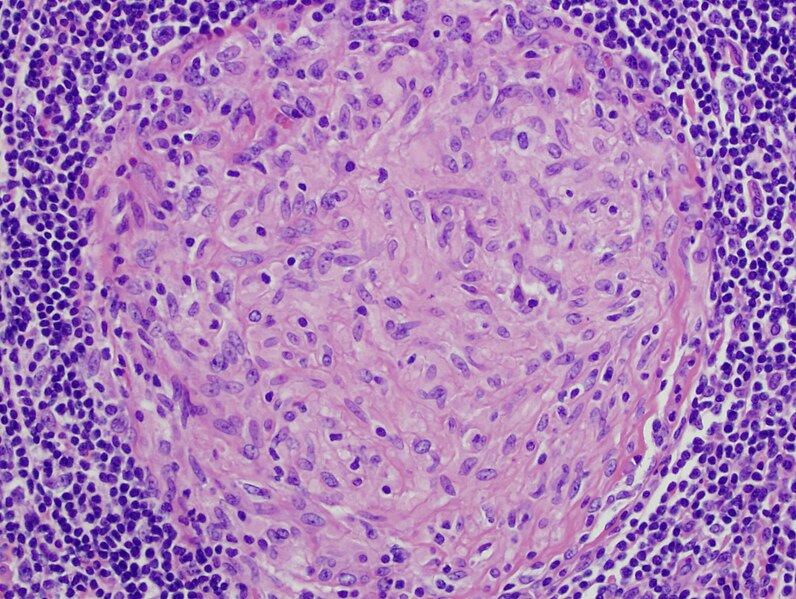
Picture of a granuloma (without necrosis) as seen through a microscope on a glass slide. The tissue on the slide is stained with two standard dyes (hematoxylin: blue, eosin: pink) to make it visible. The granuloma in this picture was found in a lymph node of a patient with Mycobacterium avium infection. Sanjay Mukhopadhyay

Once again, the macrophages and bacteria battle. If the macrophages lose, the bacteria use their advantage within this structure to spread from cell to cell.

The international team of scientists reporting this week in Cell studied genetic variants that increase susceptibility to TB in zebrafish, a ‘see-through’ animal model for studying the disease. They identified a mutation linked to lysosomal deficiency disorders. The lysosome is an important component of macrophages responsible for destroying bacteria. This particular mutation caused a deficiency in an enzyme known as cathepsin, which acts like scissors within the lysosome to chop up bacteria. This mutation, however, would not necessarily explain why the macrophages could not destroy the bacteria, as other enzymes could take cathepsin’s place.

The key, the researchers found, lay in a second property of the macrophage: housekeeping. As well as destroying bacteria, the macrophage also recycles unwanted material from within the body for reuse. Lysosomal deficiency disorders were preventing this essential operation.

Ramakrishnan, the study’s senior author, explained: “Macrophages act a bit like vacuum cleaners within the body by vacuuming up debris and unwanted material, including the billions of cells that die each day as part of natural turnover. But the defective macrophages are unable to recycle this debris and get clogged up. They grow bigger, fatter and less able to move around and clear up other material.

“This can become a problem in TB because once the TB granuloma forms, the host’s best bet is to send in more macrophages at a slow steady pace to help the already infected macrophages.”

“When these distended macrophages can’t move into the TB granuloma,” added study co-author Levitte, “the infected macrophages that are already in there burst. This leaves a ‘soup’ in which the bacteria can grow, spread further and make the infection worse.”

The researchers looked at whether the effect seen in the lysosomal deficiency disorders, where the clogged-up macrophage could no longer perform its work, would also be observed if the lysosome became clogged up with non-biological material. By ‘infecting’ the zebrafish with microscopic plastic beads, they were able to replicate this effect.

“We saw that accumulation of material inside of macrophages by many different means, both genetic and acquired, led to the same result: macrophages that could not respond to infection,” explained co-author Russell Berg.

This discovery then led the team to see whether the same phenomenon occurred in humans. Working with Joe Keane and his colleagues from Trinity College Dublin, Ireland, the researchers showed that the macrophages of smokers were similarly clogged up with smoke particles. This observation helped explain why people exposed to smoke were at a greater risk of TB infection.

“Macrophages are our best shot at getting rid of TB. If they are slowed down by smoke particles, their ability to fight infection is going to be greatly reduced,” said Keane. “We know that exposure to cigarette smoke or smoke from burning wood and coal, for example, are major risk factors for developing TB. Our finding helps explain why this is the case. The good news is that stopping smoking reduces the risk by allowing the impaired macrophages to die away and be replaced by new, agile cells.”

Also contributing to this research were David Tobin from Duke University, Cecilia Moens from the Fred Hutchinson Cancer Research Institute, C.J. Cambier and J. Cameron from University of Washington, Kevin Takaki from University of Cambridge, and Seonadh O’Leary and Mary O’Sullivan from Trinity College Dublin.

Their findings were reported in the March 24 Cell article, Lysosomal Disorders Drive Susceptibility to Tuberculosis by Compromising Macrophage Migration (10.1016/j.cell.2016.02.034)

The research was supported by the National Institutes of Health, the University of Washington Medical Scientist Training Program, the Wellcome Trust, the National Institute of Health Research Cambridge Biomedical Research Centre, the Health Research Board of Ireland and The Royal City of Dublin Hospital Trust.

Media Contacts:

Cambridge University, U.K.: Craig Brierley, +44 (0)1223 766205, Craig.Brierley@admin.cam.ac.uk
University of Washington, Seattle: Leila Gray, 206-685-0381, leilag@uw.edu

See the full article here .

Please help promote STEM in your local schools.

STEM Icon

Stem Education Coalition

The University of Washington is one of the world’s preeminent public universities. Our impact on individuals, on our region, and on the world is profound — whether we are launching young people into a boundless future or confronting the grand challenges of our time through undaunted research and scholarship. Ranked number 10 in the world in Shanghai Jiao Tong University rankings and educating more than 54,000 students annually, our students and faculty work together to turn ideas into impact and in the process transform lives and our world. For more about our impact on the world, every day.

So what defines us — the students, faculty and community members at the University of Washington? Above all, it’s our belief in possibility and our unshakable optimism. It’s a connection to others, both near and far. It’s a hunger that pushes us to tackle challenges and pursue progress. It’s the conviction that together we can create a world of good. Join us on the journey.

From U Washington: “NASA-funded consortium to support science education in Washington, Oregon and Montana”

U Washington

University of Washington

February 17, 2016
Hannah Hickey

A new program based at the University of Washington will bring together educational institutions, K-12 teachers and informal education organizations to inspire, teach and recruit the next generation of students in science, technology, engineering and mathematics.

The new Northwest Earth and Space Sciences Pipeline, or NESSP, has begun a $10 million, five-year cooperative agreement with NASA that broadens existing programs and launches new efforts throughout Washington, Oregon and Montana, with a particular focus on underserved and underrepresented communities.

“The goal is to create a virtual NASA hub in the Northwest to provide excellence in the teaching of STEM disciplines, from middle school to high school, and provide a conduit for students from across the region, including from underserved and underrepresented groups, to move into STEM careers,” said principal investigator Robert Winglee, a UW professor of Earth and space sciences.

The program establishes a regional network that will increase collaboration to boost the capacity for STEM education and experiences in the early years.

Examples of the program’s efforts include:

Expanding the Washington Aerospace Scholars program — an in-depth space science experience for high school juniors that includes an online UW course and a week at the Museum of Flight — to enroll students from Montana and Oregon.
Supporting the Red-Tailed Hawks Flying Club, a Mukilteo-based group that trains black students in aviation, to incorporate NASA curriculum and do outreach to rural areas and tribal nations across the three states.
Funding the Pacific Science Center in Seattle to hold one-day and week-long versions of its science camps in other locations in the three states, and expand the reach of its Science-On-Wheels program.
Offering in-person teacher training workshops in each state in Earth and space sciences.
Providing virtual training opportunities for K-12 teacher development, with options for teachers to share STEM resources and curriculum.
Creating more opportunities for high school students to do hands-on summer research projects on college and university campuses.

“We’re seeing a lot of growth in the Northwest region of private-sector aerospace companies,” Winglee said. “Proving a conduit for students to move into those kinds of careers is important.”

He and Carlos Chavez, a UW staff member who is associate director of the Washington Space Grant Consortium, will visit the three states this spring to do rocketry demonstrations in tribal communities and conduct teacher training with NASA curriculum. In April, they will visit the Yakama Nation in Washington and the Crow and Blackfeet nations in Montana. They will also make a similar visit this spring to Oregon.

Participating organizations include the Museum of Flight; Pacific Science Center; the Washington NASA Space Grant Consortium, an existing UW-based effort to support aerospace and STEM education; the Oregon NASA Space Grant Consortium; the Montana NASA Space Grant Consortium; Montana State University; Oregon State University; Montana’s Office of Public Instruction; the Museum of the Rockies in Bozeman; Portland’s Oregon Museum of Science and Industry; the South Metro-Salem STEM Partnership; the UW Pipeline Project; Northwest Indian College in Bellingham; First Nations MESA in Toppenish, Washington; Everett Community College; and K-12 school districts including Highline and Coulee Dam, Washington; Salem, Oregon; and Washington state’s Olympic Educational Service District and North Central Educational Service District.

The group held its kickoff meeting in January at the Museum of Flight. Erika Harnett, a UW research associate professor in Earth and space sciences, is associate director of Washington Space Grant and co-principal investigator for this cooperative agreement.

The effort is one of 27 awards selected last fall by NASA’s Science Mission Directorate to support NASA science education at institutions to encourage STEM careers.

###

For more information, contact Robert Winglee at 206-685-8160 or winglee@uw.edu, or Washington Space Grant program manager April Huff at 206-543-0213 or alhuff@uw.edu.

See the full article here .

Please help promote STEM in your local schools.

STEM Icon

Stem Education Coalition

The University of Washington is one of the world’s preeminent public universities. Our impact on individuals, on our region, and on the world is profound — whether we are launching young people into a boundless future or confronting the grand challenges of our time through undaunted research and scholarship. Ranked number 10 in the world in Shanghai Jiao Tong University rankings and educating more than 54,000 students annually, our students and faculty work together to turn ideas into impact and in the process transform lives and our world. For more about our impact on the world, every day.

So what defines us — the students, faculty and community members at the University of Washington? Above all, it’s our belief in possibility and our unshakable optimism. It’s a connection to others, both near and far. It’s a hunger that pushes us to tackle challenges and pursue progress. It’s the conviction that together we can create a world of good. Join us on the journey.

From U Washington: “Caught in the act: UW astronomers find a rare supernova ‘impostor’ in a nearby galaxy””

U Washington

University of Washington

February 12, 2016
James Urton

NGC 300
The galaxy NGC 300, home to the unusual system Binder and her colleagues studied. The spiral galaxy is over 6 million light years away. An ultraviolet image of NGC 300 taken by the Galaxy Evolution Explorer (GALEX) NASA/JPL-Caltech/OCIW

NASA Galex telescope
NASA/GALEX

Breanna Binder, a University of Washington postdoctoral researcher in the Department of Astronomy and lecturer in the School of STEM at UW Bothell, spends her days pondering X-rays.

As she and her colleagues report in a new paper published Feb. 12 in the Monthly Notices of the Royal Astronomical Society, they recently solved a mystery involving X-rays — a case of X-rays present when they shouldn’t have been. This mystery’s unusual main character — a star that is pretending to be a supernova — illustrates the importance of being in the right place at the right time.

Such was the case in May 2010 when an amateur South African astronomer pointed his telescope toward NGC300, a nearby galaxy. He discovered what appeared to be a supernova — a massive star ending its life in a blaze of glory.

“Most supernovae are visible for a short time and then — over a matter of weeks — fade from view,” said Binder.

After a star explodes as a supernova, it usually leaves behind either a black hole or what’s called a neutron star — the collapsed, high-density core of the former star. Neither should be visible to Earth after a few weeks. But this supernova — SN2010da— still was.

“SN 2010da is what we call a ‘supernova impostor‘ — something initially thought to be a supernova based on a bright emission of light, but later to be shown as a massive star that for some reason is showing this enormous flare of activity,” said Binder.

Many supernova impostors appear to be massive stars in a binary system — two stars in orbit of one another. Stellar astrophysicists think that the impostor’s occasional flare-ups might be due to perturbations from its neighbor.

For SN 2010da, the story appeared to be over until September 2010 — four months after it was confirmed as an impostor — when Binder pointed NASA’s Chandra X-ray Observatory toward NGC300 and found something unexpected.

NASA Chandra Telescope
NASA/Chandra

Supernova impostor SN 2010da circled in green and the X-ray emission indicated by a white cross.
An image obtained by UW astronomer Breanna Binder’s group using the Hubble Space Telescope, showing the supernova impostor SN 2010da circled in green and the X-ray emission indicated by a white cross. Reproduced from a Royal Astronomical Society publication.Breanna Binder/NASA/Royal Astronomical Society

“There was just this massive amount of X-rays coming from SN 2010da, which you should not see coming from a supernova impostor,” she said.

Binder considered a variety of explanations. For example, material from the star’s corona could be hitting a nearby dust cloud. But that would not produce the level of X-rays she had observed. Instead, the intensity of the X-rays coming from SN 2010da were consistent with a neutron star — the dense, collapsed core remnant of a supernovae.

“A neutron star at this location would be surprising,” said Binder, “since we already knew that this star was a supernova impostor — not an actual supernova.”

In 2014, Binder and her colleagues looked at this system again with Chandra and, for the first time, the Hubble Space Telescope.

NASA Hubble Telescope
NASA/ESA Hubble

They found the impostor star and those puzzling X-ray emissions. Based on these new data, they concluded that, like many other supernovae impostors, SN 2010da likely has a companion. But, unlike any other supernovae impostor binary reported to date, SN 2010da is probably paired with a neutron star.

“If this star’s companion truly is a neutron star, that would mean that the neutron star was once a giant, massive star that underwent its own supernova explosion in the past,” said Binder. “The fact that this supernova event didn’t expel the other star, which is 20 to 25 times the mass of our sun, makes this an incredibly rare type of binary system.”

To understand how this unusual binary system could form, Binder and her colleagues considered the age of the stars in this region of space. Looking at stellar size and luminosity, they discovered that most nearby stars were created in two bursts — one 30 million years ago and the other less than 5 million years ago. But neither SN 2010da nor its presumed neutron star companion could’ve been created in the older burst of starbirth.

“Most stars that are as massive as these usually live 10 to 20 million years, not 30 million,” said Binder. “The most massive, hottest stars can form, grow, swell, explode and leave a neutron star emitting X-rays in about 5 million years.”

Surveys of the galaxy as recently as 2007 and 2008 detected no X-ray emissions from the location of SN 2010da. Instead, Binder believes that the X-rays they first found in 2010 represent the neutron star “turning on” for the first time after its formation. The X-rays are likely produced when material from the impostor star is transferred to the neutron star companion.

“That would mean that this is a really rare system at an early stage of formation,” said Binder, “and we could learn a lot about how massive stars form and die by continuing to study this unique pairing.”

One mystery solved, Binder would like to keep looking at SN 2010da, seeing what else she can learn about its formation and evolution. Its home galaxy, which has yielded unique pairings previously, is sure to keep her busy. She is also planning a follow-up study of other recent supernova impostors with the help of an undergraduate research assistant at UW Bothell.

Co-authors on the paper included UW astronomy professor Ben Williams, Albert Kong at the National Tsing Hua University, Terry Gaetz and Paul Plucinsky at the Harvard-Smithsonian Center for Astrophysics, Evan Skillman at the University of Minnesota and Andrew Dolphin at Raytheon. Their work was funded by NASA.

See the full article here .

Please help promote STEM in your local schools.

STEM Icon

Stem Education Coalition

The University of Washington is one of the world’s preeminent public universities. Our impact on individuals, on our region, and on the world is profound — whether we are launching young people into a boundless future or confronting the grand challenges of our time through undaunted research and scholarship. Ranked number 10 in the world in Shanghai Jiao Tong University rankings and educating more than 54,000 students annually, our students and faculty work together to turn ideas into impact and in the process transform lives and our world. For more about our impact on the world, every day.

So what defines us — the students, faculty and community members at the University of Washington? Above all, it’s our belief in possibility and our unshakable optimism. It’s a connection to others, both near and far. It’s a hunger that pushes us to tackle challenges and pursue progress. It’s the conviction that together we can create a world of good. Join us on the journey.
From The Seattle Times: “UW scientists capture underwater eruption with new fiber-optic array, set up HD web cam”

Seattle Times bloc

The Seattle Times

January 17, 2016
Sandi Doughton

The idea was hatched in a bar more than two decades ago.

University of Washington oceanographer John Delaney and a colleague were nursing cocktails and venting their frustration with the traditional approach to studying the underwater world.

The ocean and seafloor are dynamic environments, with tectonic plates pulling apart, superhot fluids gushing from hydrothermal vents and an ever-shifting cast of creatures on the move.

Techtonic plates
The key principle of plate tectonics is that the lithosphere exists as separate and distinct tectonic plates, which float on the fluid-like (visco-elastic solid) asthenosphere. The relative fluidity of the asthenosphere allows the tectonic plates to undergo motion in different directions. This map shows 15 of the largest plates. Note that the Indo-Australian Plate may be breaking apart into the Indian and Australian plates, which are shown separately on this map.

But scientists could only catch glimpses of what was going on under the surface during brief, costly research cruises.

Temp 1
In its first success, a new system of cabled instruments allowed scientists to “watch” an underwater volcano erupt. Axial Seamount sits 300 miles off the NW coast under a mile of water. New lava flows, shown in orange, were up to 417 feet thick.

When his friend mentioned a new technology called fiber optics, it fired Delaney’s imagination. He grabbed a napkin and sketched out a network of sensors attached to cables that could transmit data instantly and continuously. He called it an underwater observatory.

After 25 years of pitching the idea to anyone who would listen and scrounging for money, Delaney is finally seeing that vision realized. And the scientific payoffs started with a bang that even he couldn’t have anticipated.

With the completion this month of a data portal, information and images from a suite of 140 instruments off the Northwest coast are finally flowing to scientists around the world. Even before the data were widely disseminated, the observatory allowed researchers to track, for the first time, the eruption of an underwater volcano as it happened.

“That was incredibly exciting,” Delaney said. “This signals a new era in ocean science, where the cable allows us to actually be there 24/7, 365 days a year.”

Temp 2
Hot, microbe-rich fluids flow out of a caldron in a seafloor lava flow. Scientists say microbes associated with underwater eruptions might shed light on the origins of life. (University of Washington / Ocean Observatories Initiative)

Temp 3
A cabled, high-definition camera on the seafloor near Axial Seamount streams live images of a 13-foot-tall black smoker thermal chimney,being called the Mushroom, which is covered with tube worms, palm worms and limpets. (University of Washington / Ocean Observatories Initiative)

Eruption under way

The eruption provided a serendipitous showcase for the observatory’s power to capture events that scientists had previously been able to examine only after the fact.

In April 2015, just months after a team from the UW and other institutions installed the final instruments on the $200 million cabled network and powered it up, the new seismometers detected an uptick in rumblings under a submarine volcano called Axial Seamount. Located 300 miles off the Oregon coast and covered by nearly a mile of water, the sprawling volcano straddles a ridge where the seafloor splits and new crust is born as molten rock rises from the depths.

Scientists were glued to their computer terminals, watching the shaking build to a crescendo. In one 24-hour-period, the instruments recorded more than 8,000 small quakes as magma muscled its way upward.

Then the earthquakes dropped off abruptly, as if someone had thrown a switch. At the same time, pressure sensors revealed that the seamount — which had been swelling for several years — deflated like a balloon.

That’s exactly what you would expect to see from a volcano that just ejected massive amounts of lava — but scientists weren’t sure at first where the molten rock had gone.

Then they looked more closely at the seismic data and saw bursts of small earthquakes from an unexpected location on the volcano’s northern flank. Hydrophones also picked up the sound of explosions in the area, probably generated when pressurized gas burst from the lava, said UW marine geophysicist William Wilcock.

A few months later, when a research crew visited the site by ship, Wilcock and his colleagues relied on the observations from the cabled observatory to tell them exactly where to look for freshly erupted rock.

“It was pretty neat,” Wilcock said. “They went there and found this very thick lava flow.”

A remotely operated vehicle lowered from the ship recorded stunning video of formations called pillow basalts, created as magma erupts into water, said UW oceanographer Deborah Kelley, chief scientist for the expedition. In places, the new lava was more than 40 stories thick.

Hot fluid still gushed from openings in the new seafloor. Vents called snowblowers spewed blizzards of white minerals encrusted with microbes. Mats of microscopic organisms were already beginning to colonize the newly erupted basalt.

And none of the instruments were damaged.

“We were phenomenally lucky,” Kelley said. “We got a nice eruption and it didn’t take out our array.”

Now that all the data are available, Kelley is eager to see whether the eruption generated a “megaplume” of superheated water and chemicals similar to the ash clouds that rise from volcanoes on land.

In addition to seismometers and pressure gauges, the observatory includes instruments that measure ground tilt, water temperature, oxygen levels and chemical composition. Other sensors can collect microbes and analyze their DNA. A few instruments were designed to zip up and down on vertical cables, collecting samples at different depths.

Kelley also hopes to explore the links between underwater earthquakes and eruptions and the microbes that thrive in the harsh environment — and may represent the origins of life on Earth and models for possible life on other planets.

“The idea is that this array will be in place for at least 25 years,” she said. “There are so many questions we can address.”

Dream come true

Live video from a high-definition camera on the seafloor is also streaming online now. It’s not continuous yet, but Delaney couldn’t wait to share it with his students.

“I’ve been dreaming about that for more than 20 years,” he said in his office last week, as he gazed at an image of a 13-foot-tall hydrothermal vent called a black smoker, with scalding water flowing from its top and a thick blanket of palm worms, filamentous bacteria and limpets clinging to its sides.

“What you’re looking at is what’s happening on the bottom of the ocean, 400 kilometers away — right this second,” he said, shaking his head as if he couldn’t quite believe it himself.

When Delaney proposed the underwater observatory, many scientists dismissed it as impossibly ambitious — and impossible to pull off. Others worried it would gobble up too much of the slim budget allotted to oceanographic research.

Colleagues use the word “visionary” to describe Delaney’s view of the future of oceanography and his passion for the observatory project. But it also took a lot of time shuttling back and forth between Seattle and Washington, D.C., along with nitty-gritty negotiation to build support, secure funding and orchestrate the installation, said marine geologist Daniel Fornari, of Woods Hole Oceanographic Institution.

“John is a very determined man,” Fornari said. “He lived and breathed this for two decades.”

Delaney is also eloquent in describing humanity’s connection to and reliance on the oceans, said marine scientist Maya Tolstoy, of Lamont-Doherty Earth Observatory at Columbia University. A section of Delaney’s website is devoted to Pablo Neruda and other poets who explore the mysteries of the sea and human soul.

“I would describe John as the poet laureate of the seafloor,” Tolstoy said.

After multiple delays and reductions in scope, the National Science Foundation funded the array as part of its broader Ocean Observatories Initiative.

The fiber-optic infrastructure and the scientific instruments were all in place by the end of 2014. But scientists around the world were forced to wait more than a year for completion of the data portal.

The bugs that remain in the data-delivery system aren’t enough to dim Delaney’s exhilaration at seeing the observatory begin to function as it was meant to.

And at the age of 74, he’s already looking ahead.

The existing instruments are too far offshore to closely monitor the submarine fault called the Cascadia Subduction Zone, which can unleash monster earthquakes and tsunamis. So Delaney is pushing to add a dedicated network of seismometers and pressure gauges.

He’s also enthusiastic about new, autonomous gliders and other mobile platforms capable of performing experiments and exploring the expanses between fixed instruments.

“We’re still at the very early stage with the cable,” he said. “We’re planting the seeds for the next generation of oceanography.”

See the full article here .

Please help promote STEM in your local schools.

STEM Icon

Stem Education Coalition

From U Wash: “Earth observations show how nitrogen may be detected on exoplanets, aiding search for life”

U Washington

University of Washington

September 3, 2015 [Not originally seen released.]
Peter Kelley

Temp 1
The Earth as seen by the Polychromatic Imaging Camera aboard [NOAA’s] Deep Space Climate Observatory satellite, July 2015.NASA

NOAA DISCOVR
NOAA DSCOVR

Observations of nitrogen in Earth’s atmosphere by a [NOAA] spacecraft 17 million miles away are giving astronomers fresh clues to how that gas might reveal itself on faraway planets, thus aiding in the search for life.

Finding and measuring nitrogen in the atmosphere of an exoplanet — one outside our solar system — can be crucial to determining if that world might be habitable. That’s because nitrogen can provide clues to surface pressure. If nitrogen is found to be abundant in a planet’s atmosphere, that world almost certainly has the right pressure to keep liquid water stable on its surface. Liquid water is one of the prerequisites for life.

Should life truly exist on an exoplanet, detecting nitrogen as well as oxygen could help astronomers verify the oxygen’s biological origin by ruling out certain ways oxygen can be produced abiotically, or through means other than life.

The trouble is, nitrogen is hard to spot from afar. It’s often called an “invisible gas” because it has few light-altering features in visible or infrared light that would make it easy to detect. The best way to detect nitrogen in a distant atmosphere is to measure nitrogen molecules colliding with each other. The resulting, instantaneously brief “collisional pairs” create a unique and discernable spectroscopic signature.

A paper published Aug. 28 in The Astrophysical Journal by University of Washington astronomy doctoral student and lead author Edward Schwieterman, together with astronomy professor Victoria Meadows and co-authors, shows that a future large telescope could detect this unusual signature in the atmospheres of terrestrial, or rocky planets, given the right instrumentation.

The researchers used three-dimensional planet-modeling data from the UW-based Virtual Planetary Laboratory — of which Meadows is principal investigator — to simulate how the signature of nitrogen molecule collisions might appear in the Earth’s atmosphere, and compared this simulated data to real observations of the Earth by NASA’s unmanned Deep Impact Flyby spacecraft, launched in 2005.

The craft undertook a revised mission, called EPOXI, which included observation and characterization of the Earth as if it were an exoplanet. By comparing the real data from the EPOXI mission and the simulated data from Virtual Planetary Laboratory models, the authors were able to confirm the signatures of nitrogen collisions in our own atmosphere, and that they would be visible to a distant observer.

“One of the main messages of the Virtual Planetary Laboratory is that you always need validation of an idea — a proof of concept — before you can extrapolate your knowledge to studying a potentially Earth-like exoplanet,” Schwieterman said. “That’s why studying the Earth as an exoplanet is so important — we were able to validate that nitrogen produces an impact on the spectrum of our own planet as seen by a distant spacecraft. This tells us it’s something worth looking for elsewhere.”

This confirmation in hand, the researchers used a suite of Virtual Planetary Laboratory models that simulated the appearance of planets beyond the solar system bearing varying amounts of nitrogen in their atmospheres.

The detection of nitrogen will help astronomers characterize the atmospheres of potentially habitable planets and determine the likelihood of oxygen production by nonliving processes, the researchers write.

“One of the interesting results from our study is that, basically, if there’s enough nitrogen to detect at all, you’ve confirmed that the surface pressure is sufficient for liquid water, for a very wide range of surface temperatures,” Schwieterman said.

Schwieterman and Meadows’ UW co-author is Amit Misra, who recently completed his doctorate at the UW in astronomy. Other co-authors are Tyler Robinson of the NASA Ames Research Center in Moffet Field, California, who earned his doctorate at the UW; and Shawn Domagal-Goldman of the NASA Goddard Space Flight Center, who completed a postdoctoral appointment at the UW.

For more information, contact Schwieterman at eschwiet@uw.edu, or 321-505-1605.

The research was funded by the NASA Astrobiology Institute.

See the full article here .

Please help promote STEM in your local schools.

STEM Icon

Stem Education Coalition

The University of Washington is one of the world’s preeminent public universities. Our impact on individuals, on our region, and on the world is profound — whether we are launching young people into a boundless future or confronting the grand challenges of our time through undaunted research and scholarship. Ranked number 10 in the world in Shanghai Jiao Tong University rankings and educating more than 54,000 students annually, our students and faculty work together to turn ideas into impact and in the process transform lives and our world. For more about our impact on the world, every day.

So what defines us — the students, faculty and community members at the University of Washington? Above all, it’s our belief in possibility and our unshakable optimism. It’s a connection to others, both near and far. It’s a hunger that pushes us to tackle challenges and pursue progress. It’s the conviction that together we can create a world of good. Join us on the journey.