From MIT Tech Review: “A Power Plant in Iceland Deals with Carbon Dioxide by Turning It into Rock”

MIT Technology Review

June 9, 2016
Ryan Cross

1
Photograph by Juerg Matter

The world has a carbon dioxide problem. And while there are lots of ideas on how to curtail the nearly 40 billion tons of the gas that humanity spews into the atmosphere annually, one has just gotten a boost: burying it.

Since 2012, Reykjavík Energy’s CarbFix project in Iceland has been injecting carbon dioxide underground in a way that converts it into rock so that it can’t escape. This kind of carbon sequestration has been tried before, but as researchers working on the project report today in the journal Science, the process of mineralizing the carbon dioxide happens far more quickly than expected, confirming previous reports and brightening the prospects for scaling up this technology.

Iceland’s volcanic landscape is replete with basalt. Injecting carbon dioxide and water deep underground allows the mixture to react with calcium, magnesium, and iron in the basalt, turning it into carbonate minerals like limestone.

2
Project leader Juerg Matter stands by the injection well during the CarbFix project’s initial injection. Photograph by Sigurdur Gislason

Conventional methods for storing carbon dioxide underground pressurize and heat it to form a supercritical fluid, giving it the properties of both a liquid and a gas. While making the carbon dioxide easier to inject into the ground—usually in an old oil or gas reservoir—this carries a higher risk that it could escape back into the atmosphere through cracks in the rock.

CarbFix takes carbon dioxide from the Hellisheidi geothermal power plant, the largest in the world, which uses volcanically heated water to power turbines. The process produces 40,000 tons of carbon dioxide a year, as well as hydrogen sulfide, both of which are naturally present in the water.

3
The CarbFix pilot injection site in March 2011. Photograph by Martin Stute

The new study shows that more than 95 percent of the injected material turned to rock in less than two years. “No one actually expected it to be this quick,” says Edda Aradóttir, CarbFix’s project manager. The project is already storing 5,000 tons underground per year, making it the largest of its kind. New equipment being installed this summer aims to double the rate of storage.

Aradóttir says CarbFix spends $30 per ton to capture and inject the carbon dioxide, versus $65 to $100 per ton for the conventional method. A lot of that savings comes from not having to purify the carbon dioxide; it and the hydrogen sulfide are simply mixed with additional water and injected underground.

4
CarbFix team members handle the rock core recovered from drilling at the CarbFix pilot injection site in October 2014. Photograph by Juerg Matter

See the full article here .

Please help promote STEM in your local schools.

STEM Icon

Stem Education Coalition

The mission of MIT Technology Review is to equip its audiences with the intelligence to understand a world shaped by technology.

From SA: “Can Oil Companies Save the World from Global Warming?”

Scientific American

Scientific American

April 19, 2016
David Biello

1
ENHANCED OIL: Pumping the greenhouse gas carbon dioxide underground can scour more oil out of already tapped reservoirs. Credit: © David Biello

Kevin Macumber wanted to be a forester. Today he manages about 4,000 acres of longleaf pine in Mississippi—not for the timber, but for what lies far beneath the woods. It’s black gold: oil, deep underground. And the key to getting it out is the same molecule that lets all those trees grow: carbon dioxide.

“Another day in paradise,” says Macumber as we meet at a Chevron gas station in southeastern Mississippi, about the closest thing to a landmark around here. We’re headed to the old trailer home that’s become the operational headquarters for Tellus Operating Group, a wildcat oil company with some old oil fields in this neck of the woods. I follow his black Chevy pickup down country byways until we finally turn off on a dirt road that winds through forests to the company trailer, where the coffee is fresh and Macumber can banter with a few of his workers on this warm sunny day.

The secret about old oil reservoirs below the surface is that they still have oil, sometimes a lot, but it no longer comes out easily. Companies can pump large volumes of CO2, piped in from natural deposits belowground, down into the wells, forcing out the oil that would otherwise stay put. Macumber used to work at Occidental, one of the large oil companies that helped pioneer this “enhanced oil recovery” technique in Texas. But now he’s helped found Tellus—named after one of the Roman Earth goddesses—to do the same thing in Mississippi.

Right now, Tellus gets its CO2 from a deposit called the Jackson Dome in western Mississippi, and other oil companies are using a similar approach at hundreds of old wells around the country. But Tellus is one of two U.S. oil companies that hopes to try something entirely new, any day now. Instead of piping in natural CO2, it will use the greenhouse gas captured at a coal-fired power plant just completed nearly 100 miles north of here and send it down into the reservoir, pushing oil out and leaving the greenhouse gas deep below, safely locked away from the atmosphere, so it does not add to global warming.

2
A well in the Raleigh oil field where extra petroleum scoured out of underground deposits flows back to the surface, for sale. © David Biello

At least three coal-fired power plants are under construction in the U.S. that are designed to have their CO2 emissions captured and sent to an oil field for enhanced oil recovery, including the Kemper County Energy Facility up the road from here. More arrangements like this are being made worldwide. The scheme is vital: The only way nations can meet the targets in the Paris Agreement to combat climate change is to eliminate the burning of fossil fuels or to capture emissions and find a place to store them besides the atmosphere. Sequestering the gas belowground costs money, and the only way to pay for it on a scale large enough to slow global warming is for oil companies worldwide to buy the CO2 for enhanced oil recovery. The coal plants, in return, would make money selling their CO2.

But there’s a new flaw in this game plan: cheap oil. Oil companies that today pay for CO2 to be delivered from natural deposits are in danger of losing money, because the current price of oil is so low. For now, company’s like Tellus and others have to keep CO2 flowing into their old reservoirs because if they shut down, they lose the underground pressure they spent so much money to create. But if oil prices stay too low for too long, they will no longer be able to afford to keep purchasing CO2. Then the world will lose the one prospective way it currently has for paying to keep CO2 out of the atmosphere.

Macumber says Tellus loses money on oil produced with CO2 when a barrel of oil sells below $50. Oil is currently selling for around $40 a barrel, thanks to a world awash in petroleum, perhaps because producers are scrambling to pump as much as possible, before economies move away from oil in an attempt to limit climate change. The industry has survived price swings before, but the low price now could be an early sign of a long-term decline.
One big piping system

To show me how enhanced oil recovery works in Tellus’s Raleigh oil field, Macumber takes me down the dirt road to the pipeline that makes it all possible. It carries CO2 from Jackson Dome, but the same line will one day carry CO2 captured at the Kemper facility. The only signs of the pipe are a gap in the trees that stretches for kilometers, a tiny yellow marker that says “Warning: Carbon Dioxide Pipeline,” and a little shack that houses the pumps that keep the CO2 moving underground and pressurized.

3
Pipelines for CO2 crisscross Mississippi, like this one in Smith County. © David Biello

The process is not as easy as just getting CO2 and dumping it down a well, however. A kind of mini factory needs to be built—pumps, compressors, generators for electricity, among other kit. The entire old field and wells need to be refitted to cope with CO2 going down and, more importantly, to cope with CO2-laced water (otherwise known as carbonic acid) coming back up, which eats away at machinery and metals that are not properly protected. Then there are the big electric bills that come from running all those pumps and compressors—the single largest expense, which doesn’t include the $1 million or more a mile it costs to lay an electric line through these woods to power the equipment.

Before the CO2 goes down into a reservoir it has to be pressurized up to as much as 4,500 pounds per square inch. Millions of cubic feet of the gas must be pumped underground each day. All of that costs billions of dollars in initial outlay, plus daily operating expenses. The oil company behind it must be patient, because it can take years to put enough CO2 down the hole to build up sufficient pressure to push up an extra barrel of oil out the other end. Since 1999 the largest enhanced oil recovery (EOR) company operating in Mississippi, Denbury, estimates it has spent more than $5 billion to build and operate oil facilities and pipelines using CO2 in the Magnolia State alone. A 15 percent federal tax credit helps offset some of that cost, as do various state tax exemptions, but it’s still a significant chunk of change.

4
Bringing CO2 up to the pressure needed to scour more oil out of underground reservoirs at Tellus’s Raleigh oil field. © David Biello

Once underground, the tiny greenhouse gas molecule mixes with the bigger molecules that make up the toxic stew known as oil, both helping them flow better and restoring the subterranean pressure that had been reduced by the original tapping of the petroleum. CO2 also acts kind of like dishwashing liquid; it scours out oil lurking between grains of sand. The CO2 goes down, pressure goes up and less viscous oil flows back to the surface, ready to be sold. The oil industry calls the whole operation a recycling facility: burn oil, produce CO2, capture that CO2 and use it to force out more oil to burn. If the CO2 can be captured from a coal-fired power plant, even if it ends up producing a few more barrels of oil, the overall approach can help to reduce emissions, slowing global warming.
Cheap gas a must

The trick to EOR is getting the CO2 on the cheap. Nationwide, the oil industry injects roughly 60 million metric tons of CO2 into old oil wells each year. That’s the equivalent of the pollution from 20 coal-fired power plants. Roughly 70 million barrels of oil per year are produced this way. Since 1972 CO2 has been injected into U.S. oil reservoirs continuously, resulting in an extra two billion barrels of oil and a billion metric tons of CO2 stored underground. Today about one quarter of that CO2 comes from industries that happen to be located close to old oil fields and produce lots of CO2 as a by-product, such as fertilizer manufacturing plants or cement kilns. The other three quarters is naturally occurring CO2, which simply transfers the gas from one underground reservoir to another.

Right now, CO2 can cost less than $10 per metric ton. In Mississippi roughly one ton of CO2 yields almost two barrels of oil, so $5 of CO2 per barrel is significant if oil is selling for less than $40 a barrel—and that’s before adding in all the capital costs for the equipment. The cost of dealing with CO2 can be as much as half the cost of recovering a barrel of oil this way, according to the National Energy Technology Laboratory (pdf).

Yet the practice is widespread, in part because oil prices have been much higher in recent years and because it is hard to find new multimillion barrel reservoirs these days, especially in the picked over U.S. Denbury, based in Plano, Texas, controls more than 1,000 miles of CO2 pipelines and has published reserves of 17 trillion cubic feet of the greenhouse gas, used to pump more than 70,000 barrels of oil a day. It is using CO2 at roughly 170 wells at the Tinsley oil field here in Mississippi. Everywhere the trees try to grow in around the wells, sequestering CO2 the biological way. “Grappling with the jungle is part of the business out here,” says Greg Schnacke, executive director of governmental relations for Denbury, on a tour of Tinsley.

5
Pumping petroleum from the Tinsley oil field in the Mississippi forest in Yazoo County. © David Biello

All told, there are maybe 5,000 miles of CO2 pipeline in the U.S. Despite what sounds like big numbers, “it’s not a big industry,” Schnacke notes. “It’s roughly 3 percent of U.S. [oil] production.”
Designing coal for carbon capture

If the Jackson Dome did not exist underground in Mississippi, the Kemper County Power Facility to burn coal and capture the CO2 would not exist either. In fact, geology dictates everything about this particular power plant and oil scheme: There are billions of metric tons of the dirtiest form of coal—lignite—literally underneath where Kemper was built by Mississippi Power and its corporate parent Southern Co. The lignite was laid down by an old iteration of the Gulf Coast millennia ago. Similarly, the ancient coast left lots of oil deposits, salt domes and the like.

6
The dirtiest kind of coal—lignite—mined from right next door to the Kemper County Energy Facility. © David Biello

The Kemper facility is the world’s first full-scale coal-fired power plant designed for carbon capture. The costly plant will clean the dirtiest form of coal by first turning it into a gas, then stripping off the various pollutants—acid rain–causing sulfur, smog-forming nitrogen and globe-warming carbon—before any burning. To pay for this expensive proposition, each of the pollutants gets turned into a product: sulfur into sulfuric acid for the pulp and paper industry, nitrogen into ammonia for agriculture and carbon into pure CO2 for oil companies, traveling down a new specially built pipeline 60 miles to interconnect with the existing network.

For the CO2 captured at Kemper to work for enhanced oil recovery, oil prices need to go up. Whether they do depends as much on geopolitics as geology—the vagaries of market speculation on future oil prices and how much economic pain private oil companies can take compared with their national oil company counterparts, like Saudi Arabia’s Aramco. As it stands, long-term futures contracts suggest that oil is headed to more than $40 per barrel in 2018. The world may be awash in oil at present, making it cheap, but such gluts have not lasted forever in the past—and the oil industry is gambling that it will not last forever this time either. Cheap oil usually boosts demand, which then consumes available supply, driving prices back up over time—or so it has been over the course of the 20th and early decades of the 21st centuries.

Driving back from Tinsley, Schnacke and I pass a coal train. “That’s our competition,” he observes, meaning the coal is destined for a different power plant.

“That’s your future CO2 source,” I counter. For a system of enhanced oil recovery fed by coal plants designed for carbon capture to pay off, Denbury, Tellus and every other oil company must survive current low oil prices.

The last time oil prices stayed low for a very long time was the 1980s and 1990s. But this is not the same oil industry. Now the only big finds are offshore or, perhaps, in the Arctic. These are places that require not just substantial planning but also a huge amount of money invested before the first barrel of oil appears, not unlike EOR with CO2, only with a much less certain payoff. In fact, Denbury might use the low oil prices to acquire more reservoirs on the cheap. “A lot of oil fields are capable of accepting CO2,” Schnacke notes. “It requires capital investment and time.”
Does carbon capture pay?

At the nearby Oil Field Café, everybody I ask chuckles when I observe that the fight against climate change seems to rely on burying CO2 to bring up more oil—which then gets burned to create more CO2. Yet, putting CO2 capture on coal-fired power plants and other big industrial polluters seems less a question of whether and more a question of when. The real question is: Who will pay for it?

Dumping CO2 in the sky is free, but capturing it—and even more so, storing it underground—costs money. This gap between market realities and action to combat climate change is where the government comes in, in theory. Indeed, the Clean Power Plan proposed by the Obama administration to clean up CO2 emissions from power plants relies on capture and storage to allow coal-fired power plants to continue to produce electricity, but with less climate-changing pollution. In the long run even power plants that burn natural gas will need to capture CO2.

Companies that do this get a federal tax credit of $10 for every ton up to 75 million tons, but that does not defray the massive initial expense. Kemper has cost more than $6 billion to build. “EOR is the best choice,” says Rich Esposito, a geologist turned chemist at electric utility Southern Co.

Kemper will capture roughly three million metric tons of CO2 each year. Tellus and Denbury need so much CO2 that they’ve contracted with Kemper to purchase all of it.

6
Injecting CO2 underground to get out more oil at Denbury’s Tinsley oil field. © David Biello

For the climate to benefit, however, enough of that CO2 has to remain sequestered underground after it’s done scouring out more oil, a complex calculation that also depends on how many barrels of oil—and of what quality—are ultimately produced. “All of this is for naught if we don’t get the CO2 certified as permanently sequestered,” Esposito says. Industry practice and academic research suggest that one third of the CO2 pumped underground stays there—trapped in the same microscopic holes in the rock that once held the oil—and two thirds comes back up with the petroleum. That two thirds is then topped up with fresh CO2 from the pipeline and sent back underground to scour out more oil. Few such EOR operations have come to the end of their useful lives, which means few have closed in a well that used CO2. So a full accounting of how much CO2 really gets stored is postponed for some future reckoning.

Still, CO2 for oil recovery can hardly be worse than simply dumping the greenhouse gas directly into the atmosphere, where it has already accumulated in sufficient quantity to stave off the next ice age for millennia. “We frankly believe that probably 99-plus percent of what we purchase and put into EOR remains behind,” says Dan Cole, Denbury’s vice president of commercial development. That remains to be proved.

7
Drilling cores show the rock beneath Mississippi, including sandstone that can store CO2. © David Biello

Ordinary folks fear the CO2 will simply leak upward, worrying about CO2 mingling with water to form carbonic acid that leaches heavy metals and other contaminants out of the deep. Or about it escaping directly to the surface and settling in a smothering cloud on a home or town, as happened in 1986 when Lake Nyos in Cameroon burped out a pure, invisible cloud of natural CO2 that killed more than 1,700 people. The storage benefit is obviated if there’s even a small leak that provides a path back to the atmosphere. Old wells that connect underground to newer ones could prove a problem, some of which were plugged with nothing better than a tree stump or have simply been forgotten and lost.

And in the end there is only so much CO2 the oil industry can use. Even all the oil reservoirs in the world could not handle the more than 13 billion metric tons of CO2 that come from burning coal each year, even if pipelines and the rest could be built. “We can only take a certain amount of CO2 that could potentially be captured in the future,” Cole says. “EOR can’t be the end-all answer for CO2 capture.”

The U.S. has the most oil recovered with CO2 but it is really China that needs the technology. China is the world’s largest source of CO2 pollution yet it is less capable of affording the technology to clean up its coal-burning habit. Getting more oil out of the ground, in the Jilin or Shengli petroleum reservoirs for example, could help defray the cost.

One can imagine an underground network of CO2 pipelines for EOR—and ultimately underground storage of the greenhouse gas—that grows to the size of the underground and aboveground network of oil and gas pipelines that currently exists, one that covers most continents and even extends offshore to where CO2 can most safely be buried under the seafloor. But it is also easy to imagine how many trillions of dollars it would take to build such a vast, sprawling industrial infrastructure to clean up the vast, sprawling industrial infrastructure that already exists to burn fossil fuels. And, besides EOR, there is no current way to make money from that infrastructure.

8
The start of a vast infrastructure for CO2 in the middle of Mississippi? © David Biello

Perhaps low oil prices are a practice run for life under climate change, when fossil fuels have to be forsaken, driving down their prices and driving companies to produce cleaner forms of energy. A carbon tax could make the dirtiest fossil fuels unprofitable. Low oil prices may render impossible petroleum found in difficult environments like the Arctic or far offshore in the oceans or found in difficult forms like tar sands. Even flooding old oil reservoirs with CO2 could prove too expensive to sustain in a world where oil costs $30 a barrel rather than the $120 a barrel of a few years back.

Economics is one rubric that works to keep fossil fuels in the ground. Another is the government and regulations like the Clean Power Plan. The Paris Agreement may also help. But the U.S. is in the vanguard of the effort to have coal and burn it, too. As it stands, oil fields like Tinsley or Macumber’s Raleigh will make or break prospects for cleaning the dirtiest power plants.

Fracking and CO2 are the best available routes to more oil here in the U.S., Macumber and others argue. “This is our golden child in the future,” the oil industry veteran says of his Mississippi assets. CO2 “is a fairly inexpensive commodity for what it does,” he adds. “It’s hard to beat.”

See the full article here .

Please help promote STEM in your local schools.

STEM Icon

Stem Education Coalition

Scientific American, the oldest continuously published magazine in the U.S., has been bringing its readers unique insights about developments in science and technology for more than 160 years.

From phys.org: “Researchers propose new kind of MOF to clean coal burned in power plants”

physdotorg
phys.org

December 21, 2015
Bob Yirka

1
Nanoporous structure of 1. Credit: Science Advances (2015). DOI: 10.1126/sciadv.1500421

A small team of researchers with members from India, Canada, the U.S. and Germany has come up with a new kind of metal-organic framework (MOF) to keep carbon in coal from entering the atmosphere when it is burned in power plants—thus reducing pollution and problems with global warming. In their paper published in the journal Science Advances, the team describes their new technique, and what hurdles need to be overcome for it to be used in commercial plants.

As the researchers note, most of the effort currently put into making coal a cleaner fuel source revolve around capturing the carbon dioxide that is released when coal is burned. They suggest a better alternative might be to separate out the carbon dioxide as part of the burning process, leaving clean hydrogen gas as the actual fuel used to heat water to turn turbines.

The new MOF proposed by the team involves the use of nickel and isonicotinic acid as a sponge to pull the carbon from the coal. It would be part of a process that involves burning the coal with steam under cycles of high and low pressure. They claim their approach is twice as efficient as other sponge methods and that it is also simpler, faster to make and is not harmed by moisture, making it easy to store and transfer materials.

The big catch with the process is what to do with the carbon dioxide that is separated out—capturing it, holding on to it, transporting it and ultimately storing it would represent a substantial cost outlay for any given utility, which at this point, would appear to be prohibitively high for plants that are attempting to keep electricity costs down in places where locals could not afford higher rates, such as is the case in parts of India, China and many third-world countries.

In speaking with the press, one of the researchers, Ramanathan Vaidhyanathan, suggested that this might be an issue to be brought before an international forum such as the recent Paris Climate Change Conference. He notes that rather than storing the carbon dioxide, it might be used in industrial applications, such as oil extraction or for creating new compounds.

More information: S. Nandi et al. A single-ligand ultra-microporous MOF for precombustion CO2 capture and hydrogen purification, Science Advances (2015). DOI: 10.1126/sciadv.1500421

See the full article here .

Please help promote STEM in your local schools.

STEM Icon

Stem Education Coalition

About Phys.org in 100 Words

Phys.org™ (formerly Physorg.com) is a leading web-based science, research and technology news service which covers a full range of topics. These include physics, earth science, medicine, nanotechnology, electronics, space, biology, chemistry, computer sciences, engineering, mathematics and other sciences and technologies. Launched in 2004, Phys.org’s readership has grown steadily to include 1.75 million scientists, researchers, and engineers every month. Phys.org publishes approximately 100 quality articles every day, offering some of the most comprehensive coverage of sci-tech developments world-wide. Quancast 2009 includes Phys.org in its list of the Global Top 2,000 Websites. Phys.org community members enjoy access to many personalized features such as social networking, a personal home page set-up, RSS/XML feeds, article comments and ranking, the ability to save favorite articles, a daily newsletter, and other options.

From NOVA: “The Power Plants That Can Reverse Climate Change”

PBS NOVA

NOVA

09 Dec 2015 [Just appeared]
Tim De Chant

It’s another steamy day on the outskirts of Houston, Texas. The temperatures are hovering just above 90˚ F, and my car’s air conditioning is struggling to keep up. The engine, probably laboring under the strain of the AC compressor, is groaning loudly as I hurtle down a backroad past cattle ranches and cotton fields. I’m on my way to see a promising first step in what might be our best hope for reversing climate change—not just reducing our carbon emissions, but removing CO2 from the atmosphere.

Suburban Houston is perhaps the least likely place to kick off the carbon-negative revolution. Sprawling over hundreds of square miles of south Texas’s coastal plains, the metropolitan region is bound together by cheap gas and massive ten-lane expressways flanked by three-lane access roads that feed strip mall after strip mall, each less distinguishable than the last, their parking lots brimming with full-size trucks and SUVs.

But soon, over the long horizon, under a hazy, cotton-candy sky, the near future resolves itself. Rising beneath the four towering smoke stacks of W.A. Parish—the nation’s largest fossil fuel plant—is a more modest tangle of beams and pipes known as Petra Nova. When finished, NRG’s newest five-acre chemistry kit will draw a portion of the exhaust from Unit 8, a 610-megawatt coal-fired electric generator, remove 90% of its carbon dioxide, compress the greenhouse gas, and send it to be stored in an oilfield some 80 miles to the southwest.

1
Unit 8 at NRG’s W.A. Parish plant will soon be hooked up to a carbon capture system.

Petra Nova will capture 1.6 million tons of CO2 annually, and by itself, it’s not going to do much to alleviate climate change. But the technology it uses could someday—soon perhaps—transform the dirtiest coal power plants into terraforming machines that could rein in today’s runaway CO2 levels.

In other words, by the end of this century, this coal plant, or one very much like it, could be saving the planet. But can we build enough of them in time?

Capturing Carbon

The road to the Petra Nova field office is lined with imposing steel cubes and half-finished metal frames. Cherry pickers hoist workers to dizzying heights as portable generators and compressors thrum below. I park my car and step out into the sweltering sun where I’m greeted by John Ragan, president of both NRG’s Gulf Coast region and the company’s Carbon360 business group. Ragan is a veteran of the Gulf Coast oil and gas industry, and even in his crisp white shirt and pressed slacks he seems perfectly comfortable in the heat, humidity, and organized chaos that define Southern construction sites. After a brief chat inside the mercifully air conditioned field office, we head out for a tour of the plant with Ragan, Jim Tharp, senior director at NRG overseeing construction here, and Dave Knox, senior director of communications for the company.

2
John Ragan, president of NRG’s Carbon360 business group, explains how Petra Nova’s CO2 scrubber will work once it’s assembled.

Coal-fired power plants may seem imposingly complex from the roadside, but they’re surprisingly simple. Pulverized coal is fed into the boiler and burned, turning water into steam which powers a turbine that turns a generator. Even the pollution control equipment is straightforward. In one chamber, giant bags—similar to those in a vacuum cleaner—trap particulates from the exhaust gas. In another, limestone slurry is mixed with the exhaust to react with sulfur dioxide, which produces gypsum.

Carbon capture systems are just as simple. At Petra Nova, exhaust gas flows into a 320-foot-tall tower packed with a dense thicket of metal that’s drenched in an amine solution. The CO2 reacts with water and the NH2 of the amine to produce bicarbonate (HCO3–). The solution is then pumped to a 180-foot-tall regenerator—delivered from Korea last week in one piece—which heats up the amine to release the CO2. The gas is then compressed and injected underground into an oil field to push out more crude. (When the goal isn’t oil production, it’s stored in deep saline aquifers.)

3
Exhaust gas from W.A. Parish’s Unit 8 flows through a duct to the CO2 scrubber where it reacts with an amine solution. CO2 is then released from the amine solution in the regenerator, which is powered by a natural gas power plant.

Work on Petra Nova started in 2009 after the company was awarded a $167 million grant from the Department of Energy, a little more than 10% of the demonstration plant’s estimated $1 billion price tag. “That really gave us the momentum to move forward,” Ragan says.

That momentum would soon be tested. In the early days of the Obama administration, when Democrats still controlled the House of Representatives and had a simple majority in the Senate, it was a foregone conclusion that CO2 emissions would be regulated in some fashion, most likely through a cap-and-trade program where utilities and other polluters could swap or buy emissions permits to stay under a legally mandated cap. A bill was introduced in the House, but it never made it to the Senate floor.

“When we started planning this, everyone assumed there would eventually be a price on carbon. Then there wasn’t,” Ragan says. “Our CEO David Crane told us to figure out how to make this work without a price on carbon.”

John Ward, managing director of Vivid Economics, a London-based consultancy, says that the lack of a price on carbon has scuttled a lot of similar projects. “A large part of what’s holding carbon capture and storage back is around the carbon price,” he says. For the technology to succeed, he adds, the price needs to be “sufficiently strong and reliable to make really quite significant capital investments.”

For NRG, the trick was finding someone willing to pay for the excess CO2. This being Texas, there was a nearby oilfield that could use the gas to squeeze more crude from the rock. The partnership will make Petra Nova profitable, but burning the extra oil it helps extract will counter the climate benefit of the CO2 it stores.

The Petra Nova demonstration plant, then, represents something of a hedge. For now, without regulatory or economic incentives to capture the carbon simply for storage, the project doesn’t make financial sense for NRG. But Ragan believes that’s likely to change. “We’re going to live in a carbon constrained world,” he says. “We have to do something with our existing coal power plants.”

From Neutral to Negative

There is something else that power companies can do with their existing coal power plants, and that’s burn biomass. While burning coal releases CO2 inhaled by plants millions of years ago, burning fresh biomass captures CO2 that’s circulating today. The idea isn’t new—power companies have been burning biomass for more than 20 years. Currently, there’s about 16.1 GW of biomass generating capacity in the U.S., or about 1.4% of the total. Some of that is burned in pure biomass plants, the rest in so-called co-fired plants that mix biomass with fossil fuels.

From a climate perspective, biomass energy is appealing because it burns plants, which suck CO2 out of the atmosphere as a part of everyday life. We don’t need to build specialized structures to capture CO2—we can let plants do it for us.

4
Wood pellets are frequently used as sources of biomass for power plants.

When done right, burning biomass is almost carbon neutral, where the amount of CO2 it emits is balanced by the CO2 plants absorb. The caveat is that the biomass has to be appropriately harvested or grown, with a focus on organic waste and quick-growing plants. Slow-growing hardwoods and old growth forests are definitely out of the question. “If you cut down a 100 year old rainforest, then it could take up to 400 years to pay back that debt, to make up for all that biomass that was standing perfectly happy in the Amazon,” says Daniel Kammen, director of the Renewable and Appropriate Energy Laboratory at the University of California, Berkeley. Biomass harvested for energy also has to be replaced with new plantings—if not, then burning biomass is worse than coal.

It’s tempting to think of biomass as an easy fix—that we could switch the grid from fossil fuels to biomass—but it would place enormous demands on both human ingenuity and life on Earth. “We would need something like a quarter of all the net primary production, the total plant growth on the Earth’s surface,” says Chris Field, director of the Carnegie Institution’s Department of Global Ecology. “That’s completely unrealistic.”

“But what’s a meaningful level?” he continues. “Would a meaningful level be at one, two, five percent of the global energy system? I think the answer is that we’re looking at a 21st century energy system that’s likely to have lots and lots of components so that contributions of a few percent will be meaningful. There’s every reason to think that biomass should be considered at that kind of scale.”

Even utilizing 5% of all plant growth—about 12.3 gigatons, an amount approaching the productivity of the world’s farms—won’t do much to tamp down carbon emissions. In fact, biomass is not quite carbon neutral because it still has to be harvested and hauled before it’s combusted, and right now, both require fossil fuels. On balance, burning biomass still releases CO2, just less than burning coal.

But the good news is that biomass power plants, just like their coal cousins, release their CO2 in conveniently concentrated streams of hot gas. And as projects like Petra Nova and others are demonstrating, we know how to capture and store CO2 from those emissions.

So to start removing CO2 from the atmosphere—and possibly begin reversing climate change—all we have to do is combine them. “The innovation is putting the two together,” Kammen says.

Best of Both Worlds

Scrubbing CO2 from power plant emissions is based on old technology. The amine-based process used at Petra Nova and other carbon capture and sequestration (CCS) plants has been around for for a long time. “It was patented in the 1930s,” says Howard Herzog, a senior research engineer at MIT’s Energy Initiative. “The process has improved since then, but the fundamentals are basically the same. You’ve got something that’s been around 80 years and developed. A lot of the issues have been worked out.”

The idea to combine bioenergy with CCS had emerged early in the 1990s, and the original goal was to make coal power stations carbon neutral. A little later in the decade, other scientists started exploring how to remove CO2 directly from the atmosphere. It wasn’t until 2001, when Kenneth Möllersten, an engineer with the Swedish Energy Agency, and Jinyue Yan, a professor at the Swedish Royal Institute of Technology, put two and two together. Rather than push the limits of chemistry to capture CO2 from the open air, they realized that we could let trees, grasses, and other plants do the hard work. All we’d need to do is collect and burn them, capture the CO2, and find somewhere to store it for a long, long time.

5
A crane lowers a piece of the CO2 scrubber into place at Petra Nova.

Burying the CO2 from power plants deep underground has some inherent benefits. Unlike forests, which are also excellent long-term carbon sinks, stored CO2 can’t easily be rereleased. Once buried, it isn’t likely to surface for thousands, perhaps millions, of years. Today, we have no way of guaranteeing that a forest will be left standing for that long. Plus, all plants eventually die and decay, releasing their carbon. Bioenergy with CCS is a best-of-both-worlds approach. With it, we can take advantage of plants’ natural ability to capture CO2 and then use a proven technology to lock those emissions away.

“Neither piece of what we’re talking about, individually, is technically hard,” Kammen says. “But then when you start looking at it as a system, then it gets interesting.”

Searching for Supplies

Recently, Kammen and a handful of his students decided to see if, by 2050, they could reduce carbon emissions by 145% below 1990s levels for a chunk of North America known as the Western Interconnection—the regional power grid that supplies the Western U.S., the Canadian provinces of Alberta and British Columbia, and a chunk of Baja California in Mexico. Essentially, they would be transforming a region from one that produced CO2 pollution into one that would remove it from the atmosphere.

They started their simulation by replacing nearly all fossil fuel power sources with renewables, including wind, solar, hydro, and geothermal. Then they ramped up biomass energy with CCS, also known as BECCS, to provide an always-on source of power that also removed CO2 from the atmosphere. By 2050, they were using nearly all available biomass supplies, which included everything from trash to orchard waste and wood from fast growing trees.

Biomass energy’s insatiable demand for combustible material is usually where it hits a roadblock. There’s only so much biomass to go around, and collecting and trucking it to various power plants will require entirely new supply chains that don’t currently exist. “It becomes increasingly expensive to supply large quantities of biomass as opposed to smaller quantities,” says Ed Rubin, a professor of engineering and public policy at Carnegie Mellon University. “Most biomass facilities are relatively small—an order of magnitude or sometimes two orders of magnitude smaller than a typical coal fired plan. It’s a supply issue.”

The current cost of supplying biomass is what’s kept NRG from co-firing any of their 19 coal plants with biomass. “We have explored biomass options at a number of plants across our fleet,” says Knox, the senior director of communications. “The problem we have encountered is getting a guaranteed and consistent supply that is close enough to the plant that you do not add to your carbon footprint through carbon-intensive trucking of the biomass.”

There’s also the danger that if BECCS is a runaway success it will start eating into food supplies. “We’re going to have to feed 9–10 billion people by 2050,” says Pete Smith, a professor of plant and soil science at the University of Aberdeen. “People are asking, is this the best use of land when we’ve got all these additional mouths to feed?”

Still, there are sources of biomass that can be used responsibly. “The clearest pool of biomass that’s available is waste products in agriculture and forestry,” says Field, the Carnegie Institution director. “That’s hundreds of millions of tons. It’s not a trivial quantity, but it’s not enough to dominate energy system. Whether there’s more biomass available really depends on one thing, critically: how much we’re able to increase agricultural yields in years ahead.”

Kammen’s study lists a variety of biomass options that wouldn’t eat into the food supply, from municipal waste to sawdust and dead corn stalks. At its most aggressive, the simulation also relies on wood and switchgrass grown specifically for BECCS, but those represent only a little more than 10% of the total biomass energy.

6
The post-harvest remains of corn stalks, known as corn stover, is a potential source of biomass.

Still, to roll out BECCS on a wide scale, the demands for land could be massive, especially if only dedicated crops were used. “This would be on an order of magnitude of several hundred megahectares of land,” says Sabine Fuss, head of sustainable resource management and global change at Mercator Research Institute on Global Commons and Climate Change in Berlin. A paper published this week by Smith, Fuss, and others suggests that relying on dedicated crops—no municipal, agricultural, or forestry waste—would consume between 320–970 megahectares of land. Currently, there are about 1,600 megahectares, or about 4 billion acres, of land under cultivation.

Then there’s the issue of transporting the resulting CO2 to a storage location. “We need an infrastructure in place to do that,” Smith says. “That’s probably an infrastructure on the size that we currently use to move gas and oil.”

Those are big hurdles, but none of the experts I spoke with saw them as insurmountable. “This is something that we could, in limited amounts, do yesterday.” Kammen says. “We’re already doing all of it, just not in a coordinated way.”

Key Piece of the Puzzle

NRG expects their Petra Nova carbon capture project to be operational sometime next year, which means it will have taken about six years to move from planning to completion. In terms of large capital projects based on new technology, that’s relatively quick, and as more are built, we’ll probably get faster at it.

But can we build them quickly enough? Nearly everyone I spoke with said the optimal time to to deploy BECCS was yesterday. Realistically, though, Petra Nova’s timeline seems about right. “It’s probably instructive to look backwards a bit before you look forward to see how quickly other kinds of technologies have been deployed absent a true wartime footing,” Rubin says. New natural gas power plants, he says, take about three to four years to build, while new coal plants take about eight to ten.

7
Start to finish, Petra Nova will take about six years to plan, engineer, and build.

The International Energy Agency estimates that about $4 trillion will have to be spent building CCS facilities between now and 2050. That may seem like a vast sum, but consider that countries around the world currently subsidize fossil fuels at more than quadruple that amount, or about $490 billion every year. If that figure holds constant for the next 35 years, we’ll have spent $17 trillion of public money supporting oil and gas. (They receive the vast amount of subsidies—coal only gets about $3 billion per year.)

We may not have to build entirely new power plants, either, but just add CCS to existing ones. Here again, the Petra Nova retrofit can be instructive. “One way you could ease into a BECCS environment is looking at coal fired power plants and beginning to increase the fraction of biomass you burn in those,” Field says. Many coal plants can already burn small amounts of biomass with few if any modifications. “If you’re cofiring those with biomass, that provides a possibility of a carbon negative component of a system that you can scale in in a very gradual way so you’re beginning to make a difference right away. You could think about having thousands of power plants that are running 5–10% biomass in a way that really begins to change the equation and doesn’t require building any new power plants.”

But, Kammen is quick to caution, “we’re not going to solve the climate story with BECCS.” Pete Smith agrees, seeing “BECCS, rather than a magic bullet, being another piece—and maybe another significant piece—of a jigsaw of future possibilities.”

We’ll still have to move most of our power supply to renewables like wind and solar, but BECCS seems too promising to overlook. “The big upside of BECCS is that you have something which solar, wind, and geothermal can’t get you, and that is an ability to make up for our past emissions and draw carbon numbers down,” Kammen says. “We’re so far above a reasonable trajectory that we’re going to need carbon negative.”

See the full article here .

Please help promote STEM in your local schools.

STEM Icon

Stem Education Coalition

NOVA is the highest rated science series on television and the most watched documentary series on public television. It is also one of television’s most acclaimed series, having won every major television award, most of them many times over.

From EPFL: “Putting carbon back where it came from: underground”

EPFL bloc

École Polytechnique Fédérale de Lausanne EPFL

17.12.15
Jan Overney
Lionel Pousaz

1
Lyesse Laloui

Will the future run entirely on renewables? According to Lyesse Laloui, the Paris Climate Conference could be catalytic, but in the meantime, we may have to bury our CO2 emissions underground.

The UN Climate Conference ended with a promising deal to reduce our impact on the climate, ratified by all 190 participating countries. It remains to be seen if and how these ambitious goals will be met. But one thing is for sure: technology will certainly be part of the solution. For example, underground carbon sequestration is among the most mature and proven technologies that could play a crucial role during the transition period that lies ahead until renewable energy becomes the norm, according to Lyesse Laloui, the director of the Petrosvibri Chair in Geoengineering and CO2 Storage. The idea he advocates involves burying our CO2 emissions underground until we are able to get by without them.

Will the decisions taken during the global climate conference boost the development of CO2 sequestration technology?
My first general and positive observation is that there is now a unanimous agreement that the atmosphere is warming, and that, consequently, we have to do something about carbon. In terms of my work, this consensus creates an opportunity. The solution we are working on is not the only one, but it is one that addresses the commitments that were made.

What role will carbon sequestration play in the future?
Today, it is the only technology capable of addressing the accumulation of carbon dioxide in the atmosphere. Over 70 projects have proven its feasibility, and since about 15 years, large industrial projects each sequester about one million tons of CO2 underground each year. And unlike oil and gas extraction, CO2 can be sequestered anywhere on the planet.

How would you explain that we don’t rely more on CO2 sequestration, even though it is a mature technology?
The obstacles are primarily financial. Capturing and storing one ton of CO2 costs about 60-70 euros. But it only costs 10 euros to buy certificates to emit a ton of CO2 on the European carbon exchange market. We cannot significantly bring down the cost of carbon capture and sequestration anymore, which his why it will either take a lot of political will or an increase in the price of carbon certificates.

Switzerland expressed its political will by announcing the shutdown of its nuclear power plants. Could CO2 sequestration help facilitate the transition?
Until renewable energy technologies are able to replace nuclear power, Switzerland will not be able to produce enough indigenous power. Gas-powered thermal power plants are being considered to step in, but these emit CO2. Swiss legislation requires that 50% of CO2 emissions produced in such a scenario be compensated on Swiss soil. An efficient transitional solution could be to set up a CO2 capture and storage facility right next to the power plant.

Are the Swiss authorities taking this idea seriously?
For the time being there are no concrete plans to move in this direction. But with support from the Swiss Federal Department of Energy, we are currently working on selecting potential sites to run a full-scale pilot test – 5 to 10,000 tons of CO2 per year – to prove the feasibility of the technology in Switzerland. But we are far from knowing at what pace this will develop.

Technically, how exactly does the technology work?
There are three steps. First, the CO2 has to be captured from the emission source. Next, it has to be concentrated and transported to the storage site. Then comes the final step, in which the CO2 is sequestered underground. To do so, we take advantage of a particularity of CO2: when it is injected into low enough depths, the high temperature and pressure transform it into a so-called “supercritical state”, where it occupies 500 times less volume than when it is a gas!

Does CO2 sequestration pose any risks?
As in all human activities, there are both short- and long-term risks. The short-term risks are primarily due to the pressure at which CO2 is injected underground. This can, for example, lead to the activation of faults that might trigger small earthquakes or allow gas to potentially leak out. We control these risks by understanding the physical mechanisms involved in these processes as well as possible and by developing predictive tools. A longer-term risk is that supercritical CO2, which is highly acidic, could destabilize the geological layers sealing the storage site. But we have technological solutions to prevent such events, either through real-time monitoring or by appropriately designing the projects.

This is also what much of your recent research focuses on.
Indeed. For example, we are investigating the impact of supercritical CO2 on the geological reservoir into which it is injected, in terms of both permeability and resistance of the rock. Aside from that, we are also focusing on the impact on the cap-rock, which is the rock layer that seals the reservoir. In both cases, we are interested in how these rocks react when they come into contact with the acidic supercritical fluid. We are one of the few groups in the world that are able to carry out these types of experiments in the lab. To do so, we developed facilities in which we can reproduce the conditions encountered in depths down to seven kilometers. In another project, we developed tools to appropriately design the installations used to sequester CO2, and to predict the behavior of the rock layers over several years after the gas is injected.

Lyesse Laloui is organizing an international conference at EPFL at the SwissTech Convention Center on greenhouse-gas control technologies in partnership with the International Energy Agency, which will take place in November 2016. Around 2000 participants are expected to attend, including experts from industry and academia, as well as decision-makers. For more information: http://www.ghgt.info/ghgt-13

See the full article here .

Please help promote STEM in your local schools.

STEM Icon

Stem Education Coalition

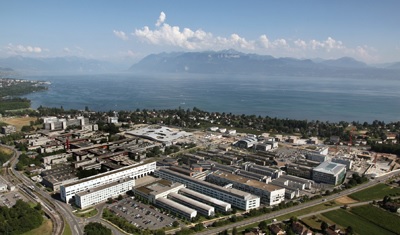
EPFL campus

EPFL is Europe’s most cosmopolitan technical university with students, professors and staff from over 120 nations. A dynamic environment, open to Switzerland and the world, EPFL is centered on its three missions: teaching, research and technology transfer. EPFL works together with an extensive network of partners including other universities and institutes of technology, developing and emerging countries, secondary schools and colleges, industry and economy, political circles and the general public, to bring about real impact for society.

From Carnegie: “Structure revealed: Plant sugar transporter involved in carbon sequestration”

Carnegie Institution for Science

October 19, 2015
No Writer Credit

Like humans, plants are surrounded by and closely associated with microbes. The majority of these microbes are beneficial, but some can cause devastating disease. Maintaining the balance between them is critical. Plants feed these microbes, and it’s thought that they do so just enough to allow the good ones to grow and to prevent the bad ones from gaining strength. This system of microbe feeding is mediated by proteins called sugar transporters.

Carnegie’s Wolf Frommer previously identified a unique class of sugar-transport proteins, called SWEETs, which play key roles in plants such as producing nectar, exporting energy manufactured in the leaves to the other plant organs, and filling seeds with nutrients to feed a plant embryo.

In two separate papers, he and several teams of researchers unravel the molecular structure of SWEET2, a transport protein that plays a critical role in limiting the sugar supply available to root microbes to the right level. This is the first time the structure of a member of the SWEET class of proteins has been described, and only one of three structures elucidated so far for sugar transporters in animals and plants.

One team, led by the Stanford University School of Medicine’s Liang Feng, an assistant professor of molecular and cellular physiology, elucidated the molecular structure of a SWEET2 transporter from rice. Discovering the structure of SWEET2, combined with determining key amino acids in the protein necessary for function, is the key to figuring out the mechanism by which it works. This is important for understanding what happens when the transporter fails due to disease or pathogens and for learning how to protect against these risks. Their work is published October 19 by Nature.

Frommer and Feng had previously worked together to determine the structure and mechanism of the bacterial analog to SWEET transporters, called SemiSWEETs. It has been predicted that SWEETs arose by a doubling and fusion of the bacterial version of the transporter genes during evolution. The similarities they found between the structural folds of the SemiSWEET dimer (a complex of two identical units that associate) and SWEET2, combined with their evidence that SWEET2 likely functions as part of a complex built of cooperating units of individual proteins, strongly support this theory.

The other team—on which Frommer worked with Carnegie postdoc Woei-Jiun Guo (now at National Cheng Kung University) and Dorothea Tholl of Virginia Tech—focused on SWEET2’s role in protecting the mustard plant Arabidopsis from parasitic infection. They show that SWEET2 helps stockpile sugars in a storage bubble inside of plant cells called the vacuole, thereby limiting the sugar supply intended to feed only the good microbes to a level that prevents the growth of the bad guys. This work has been recently published online by The Plant Journal.

Plants secrete sugar into the soil immediately surrounding their roots. Although the molecular mechanisms for this are poorly understood, it is thought that the sugar is a reward for symbiotic microorganisms living in this region that facilitate the plant’s growth. However, this sugar can also be taken up by pathogens, such as the parasite Pythium. Pythium is what’s called an oomycete, similar to a fungus, which is responsible for root-rot and other diseases in field and greenhouse crops.

The research team showed that SWEET2 facilitates the retention of sugar in roots, which could be a mechanism of starving and resisting pathogens living in the immediate root surroundings. They found that SWEET2 expression was increased 10-fold during Pythium infection and that specially created mutants lacking SWEET2 were more susceptible to the parasite.

“Together, these two papers provide first insights not only into how plants control carbon sequestration into the soil, but also improve our understanding of the functioning of this unique class of SWEET transporters, including the important human SWEET homolog,” Frommer said.

Stanford’s Liang Feng remarked: “This research is an important step in understanding the sugar transport process and energy homeostasis in cells.”

Other authors on the Nature paper include: lead author Yuyong Tao, as well as co-authors Shuo Li and Yan Xu of the Stanford School of Medicine; Carnegie’s Lily Cheung, Joon-Seob Eom, and Li-Qing Chen; and Kay Perry of APS and Cornell University.

Other authors on The Plant Journal paper include lead author Hsin-Yi Chen, as well as co-authors Ya-Chi Yu and Li-Hsuan Ho of National Cheng Kung University; Carnegie’s Li-Qing Chen; and Jung-Hyun Hug of Virginia Polytechnic Institute and State University.

1
On the top left is a side view of the two identical bacterial SemiSWEET units, which together form the transport pore shown on the top right. On the bottom left is a side view of the plant sugar transporter SWEET2, in which the two units were fused via an additional helix (#4) to form a similar pore as in the SemiSWEET dimer from only a single protein, as shown in the bottom right.

The Nature paper was supported by Stanford University, the Harold and Leila Y. Mathers Charitable Foundation, the Alfred P. Sloan Foundation, National Natural Science Foundation of China, the Division of Chemical Sciences Geosciences and Biosciences Office of Basic Energy Sciences at the US Department of Energy, the National Science Foundation, and the National Science Foundation Postdoctoral Research Fellowship in Biology. Part of this work was based upon research conducted at the Advanced Photon Source on the Northeastern Collaborative Access Team, which are supported by a grant from the National Institute of General Medical Sciences from the National Institutes of Health. Use of the Advanced Photon Source, an Office of Science User Facility operated for the U.S. Department of Energy (DOE) and the Office of Science by Argonne National Laboratory, was supported by the U.S. DOE.

The Plant Journal paper was supported by the Ministry of Science and Technology Taiwan, the Office of Basic Energy Sciences of the US Department of Energy, and the National Science Foundation.

See the full article here .

Please help promote STEM in your local schools.

STEM Icon

Stem Education Coalition

Carnegie Institution of Washington Bldg

Andrew Carnegie established a unique organization dedicated to scientific discovery “to encourage, in the broadest and most liberal manner, investigation, research, and discovery and the application of knowledge to the improvement of mankind…” The philosophy was and is to devote the institution’s resources to “exceptional” individuals so that they can explore the most intriguing scientific questions in an atmosphere of complete freedom. Carnegie and his trustees realized that flexibility and freedom were essential to the institution’s success and that tradition is the foundation of the institution today as it supports research in the Earth, space, and life sciences.

From NOVA: “$20 Million Xprize Wants to Eliminate Waste Carbon Dioxide”

PBS NOVA

NOVA

29 Sep 2015
Tim De Chant

Five out of five climatologists agree—we’re probably going to emit more CO2 than we should if we want to prevent the worst effects of climate change.

Fortunately, there’s a solution—capturing that CO2 and doing something with it. Unfortunately, the “somethings” that we know of with are both costly and not that profitable. A new Xprize announced this morning aims to change that. Funded by energy company NRG and COSIA, an industry group representing Canadian oil sands companies, the prize will fund the teams that develop the most valuable ways to turn the most CO2 into something useful.

1
A smokestack vents emissions to the atmosphere.

“It’s the second largest prize we’ve ever launched,” Paul Bunje, senior scientist of energy and environment at Xprize, told NOVA Next. “It’s a recognition of a couple of things: One is the scale of the challenge at hand—dealing with carbon dioxide emissions is obviously an epic challenge for the entire plant. Secondly, it also recognizes just how difficult, technologically, this challenge is.”

Starting today, teams have nine months to register, and by late 2016, they’ll need to submit technical documentation in support of their plans. A panel of judges will then pick the best 15 in each “track”—one which captures emissions from a coal-fired power plant, the other from a natural gas-fired plant.

The 30 semifinalists will then have to develop laboratory-scale versions of their plan. The best five from each track will receive a $500,000 grant to help fund the next stage, where teams will have to build demonstration-scale facilities that will be attached to working power plants. Four and a half years from now, a winner from each track will be chosen and be awarded $7.5 million.

Bunje, who is leading this Xprize, hopes the prize will show that “CO2 doesn’t just have to be a waste project that drives climate change—rather, that you can make money off of the products from converted CO2,” he said. “That kind of a perception shift will be pretty remarkable.”

See the full article here .

Please help promote STEM in your local schools.

STEM Icon

Stem Education Coalition

NOVA is the highest rated science series on television and the most watched documentary series on public television. It is also one of television’s most acclaimed series, having won every major television award, most of them many times over.

From NYT: “Carbon Cuts So Sharp Even California Democrats Are Divided”

New York Times

The New York Times

SEPT. 4, 2015
ADAM NAGOURNEY

1
Wednesday evening’s commuter rush on Interstate 110 in Los Angeles. Legislation in California’s long-term campaign against emissions calls for a 50 percent reduction in petroleum use by Jan. 1, 2030. Credit Monica Almeida/The New York Times

With President Obama back from a trip to Alaska in which he portrayed the fight against climate change as an urgent international priority, California is showing how hard it can be — even in a state overwhelmingly controlled by Democrats — to get an ambitious carbon reduction bill passed.

The state has been at the forefront of global efforts to battle greenhouse gases, enacting mandates to force sharp reductions in emissions over the next 35 years. Its environmental record was applauded by Mr. Obama last week, and Pope Francis invited Gov. Jerry Brown to discuss the fight against global warming in the Vatican this summer.

But a centerpiece of California’s long-term campaign against emissions — legislation requiring a 50 percent reduction in petroleum use by Jan. 1, 2030 — has set off a fierce battle here, pitting not only a well-financed oil industry against environmentalists, but Democrat against Democrat. The bill easily passed the Senate, but it is faltering in the Assembly because of opposition by moderate Democrats, many representing economically suffering districts in central California. A vote is expected early next week.

The legislation faces an onslaught by the Western States Petroleum Association and other oil industry advocates that, in ads and mailings, assert that a 50 percent cut in petroleum use could result in gas rationing and a ban on minivans.

“This law will limit how often we can drive our own cars,” a narrator in one ad says urgently, an assertion the bill’s sponsors say is groundless. The oil industry has tagged the bill “the California Gas Restriction Act of 2015.”

A defeat would be a setback for Mr. Brown, who has made a battle against global warming a centerpiece of his final years in public life, and for environmentalists who have looked to California to lead the emissions fight at a time of strong skepticism about global warming in Washington. Mr. Obama urged California lawmakers to enact the bill in a recent speech in Las Vegas, signaling the importance he is attaching to the issue in his final years in office.

The environmental fight here comes on the eve of the United Nations climate change conference in Paris this fall. There, Mr. Brown and Kevin de León, the State Senate Democratic leader, who led the fight for the bill in his chamber, are planning to outline for an international audience California’s campaign against greenhouse gases. On Wednesday, the Legislature passed and sent to Mr. Brown a measure requiring the state’s public pension funds to divest from coal companies.

“The rest of the world is watching very closely what is happening in California, and I think so far they see a success story,” Mr. de León said. “Our economy has grown — we are adding jobs, and we are reducing our carbon emissions. Therefore, it is absolutely crucial that this measure passes, because it will be a big blow to the rest of the states and the whole world if it doesn’t.”

California has mandated an 80 percent cut in emissions by 2050, using 1990 emissions levels as a baseline. The goal has been championed by Democrats like Mr. Brown and Republicans like former Gov. Arnold Schwarzenegger. This bill on petroleum, one of several the Legislature is voting on to put these limits in place, is intended to ensure that California meets this target.

The legislation, Senate Bill 350, leaves it to the state’s Air Resources Board to determine how the 50 percent mandate would be met; it does not mention gas rationing or a ban on minivans. It also includes no penalties in case the mandate is missed. Opponents, in defending the warnings about rationing, noted that the bill is short on specifics on how the reduction would be achieved; they said they saw no other way the mandate could be met.

“I can’t figure out any other way to reach a 50 percent reduction in that frame without doing some pretty dramatic measures,” said Catherine Reheis-Boyd, the president of the Western States Petroleum Association. “If it isn’t gas rationing, what is it? I keep hearing what it isn’t.”

Mr. Brown said in an interview in his office here that the oil industry was using fear tactics to try to derail the effort before the Legislature adjourns on next Friday, but that he was confident of eventual success.

“You’ve got the oil companies fighting Pope Francis,” Mr. Brown said. “Fighting the scientists of the world. Fighting the governor of California. They are engaged in literally a life-and-death struggle, and I have no doubt who is going to be the victor.”

He added: “It’s a shameless effort to maintain their revenue stream — regardless of what the impact is on everyone else. There is no rationing in the bill. Read it. None.”

The concerns have come not only from Republicans, but also from moderate Democrats who represent communities in central California. Many of these communities are struggling with high unemployment and slow economic growth.

“So much of our economy is driven by the use of petroleum,” said Assemblyman Henry T. Perea, a Democrat from the Central Valley and a leader of moderates in his house. “We don’t know what impacts S.B. 350 will have on it. We don’t know because we don’t know what the plan is. What does that look like? We haven’t heard that answer to that. And in the absence of information, you create your own.”

Kristin Olsen, the Assembly Republican leader, said her party was eager to find ways to curb harmful emissions. “My son has asthma — of course I want clean air,” she said. But she questioned why California had to be a leader in an effort that she argued had such significant economic costs.

“We want to be leaders,” she said, “but not when there are no followers. And at some point we have to look at the fact that no one is following California’s lead. We are less than 1 percent of the world. At some point we should work on reasonable, cost-effective measures to reduce greenhouse gas emissions to improve our air quality. But not at the cost of jobs.”

Ms. Boyd of the petroleum association said the bill’s sponsors had erred in trying to push the measure through without explaining how it might work. “We think there should be a lot more detail, and it should be articulated pretty clearly about how one thinks they are going to be about this superaggresive mandate,” she said.

Backers of the bill said reductions would be achieved by, among other things, bolstering the fuel efficiency of existing cars and increasing the number of electric cars on the roads, while pushing urban planning policies that help enable people to walk to their jobs and to shopping districts.

“We don’t have a choice — we have to make these changes,” said Tom Steyer, a billionaire hedge fund manager and environmental advocate who has been championing the bill. “In listening to these people talk about how there is going to be rationing, I’m like, ‘Stop making up stories, and start telling us what will happen under your scenario.’ ”

“We are in the process of changing how we use energy in the United States of America,” Mr. Steyer added. “The way this happens is, the private sector comes up with new ideas, and people either like them or not.”

Mr. de León, the leader of the State Senate Democrats, said he was preparing amendments to his bill to try to ease concerns. One amendment would give the Legislature more of a say over the final recommendation by the Air Resources Board.

Mr. Brown said that even if this bill was defeated, enough other legislation was already in place that he was confident of long-term victory.

“This is not the whole battle,” Mr. Brown said. “This bill has become a lightning rod. It’s important. But California is way down the road in terms of the thrust and momentum that has been building up for over a decade.”

See the full article here.

Please help promote STEM in your local schools.

STEM Icon

Stem Education Coalition

From AAAS: “A carbon capture strategy that pays”

AAAS

AAAS

19 August 2015
Hanae Armitage

1
Researchers have invented a process that turns atmospheric carbon dioxide into carbon nanofibers. The Lighthouse/Science Source

As rising levels of atmospheric greenhouse gases continue to threaten drastic climate change, some scientists are scouring for ways to scrub the key offender, carbon dioxide (CO2), right out of the air. Now, a team of chemists led by Stuart Licht at George Washington University in Washington, D.C., thinks it has discovered a method that could possibly pay for itself by making something potentially useful out of the CO2 pulled from the air. Today in Nano Letters, the group presents a process that turns atmospheric CO2 into carbon nanofibers similar to valuable materials used in industries such as aerospace, construction, and electronics.

“It’s clearly interesting and exciting research, but it’s a first step,” cautions James Tour, a nanoengineering and materials scientist at Rice University in Houston, Texas, who is not part of the study. “There’s still a lot of work to be done.”

The conversion process, called STEP (for Solar Thermal Electrochemical Process), is powered by sunlight, heat, and a small electrical kick. The researchers simply run a current between two electrodes in a crucible filled with molten lithium carbonate, which melts at 723°C, and a few types of metal. To start the process, the molten lithium carbonate absorbs CO2 from the air. The electrical current then busts apart the CO2 molecules through a process called electrolysis, and the carbon atoms swarm to the negatively charged electrode. Ordinarily, the carbon just forms useless gunge—which makes this form of carbon capture a sure loser. But the researchers found that if they seasoned the lithium carbonate with just the right metals, they could form more valuable carbon nanotubes instead. First, zinc sparks the process of nanofiber formation. Then, one of four other metals (nickel, cobalt, copper, or iron) acts as a scaffold, known as a nucleation site, on which the nanofiber continues to grow. The team found that with the right combination of metals, voltage, and temperature, STEP’s coulombic efficiency (a classic measure of chemical yield used to determine how efficiently the product is made) hovered around 95%, meaning that in STEP’s case, 95% of the current worked toward producing the carbon nanofibers, and only 5% powered other side reactions.

“It’s very exciting, and I think it’s a viable option in providing a scientific and technological solution to decreasing the CO2 in the atmosphere,” Licht says. In particular, he and his team hope STEP could provide a less expensive way to make carbon nanofibers. The materials—noncylindrical cousins of carbon nanotubes, composed of chains of carbon atoms less than a micrometer wide—are used in making composite materials, chemical catalysts, and even Scanning probe microscopes. But they are frustratingly costly to manufacture. Cutting the price through STEP would be a real “game-changer,” Licht says: Cheaper nanofibers would lead to greater commercial use and, in turn, to less carbon in the atmosphere. Licht says that using STEP in an area less than 10% the size of the Sahara desert could bring CO2 in the atmosphere down to preindustrial levels in just 10 years. (Side note: 10% of the Sahara desert is more than twice the area of California—that’s a lot of molten lithium.)

First, though, STEP would require some serious upscaling. One major hurdle, Tour says, is that STEP can’t yet produce usable nanofibers. “It’s like when you shear a sheep and you get wool,” he says. “Those little wool fibers that first come off its back—you can’t make a blanket out of that. You have to somehow get it spun into long fibers that you can then put into a machine to get a wool sweater or blanket.” Until scientists learn to spin STEP’s carbon nanofibers into long commercially usable fibers, he says, it’s too early to hail the process as an environmental breakthrough. But Andrew Bocarsly, a physical inorganic chemist at Princeton University who is not part of the study, says the team’s results are encouraging despite such open questions. “Even if Licht’s work only uses up 0.1%, or even 0.01% of the CO2 that we’re generating, it would be a great start,” Bocarsly says. “It’s not the solution, but it might be part of the solution.”

See the full article here.

The American Association for the Advancement of Science is an international non-profit organization dedicated to advancing science for the benefit of all people.

Please help promote STEM in your local schools.
STEM Icon
Stem Education Coalition

From Princeton: “On warmer Earth, most of Arctic may remove, not add, methane (ISME Journal)”

Princeton University

August 14, 2015
Morgan Kelly

1
McGill Arctic Research Station during late-spring at Expedition Fjord, Axel Heiberg Island, Nunavut, Canada. (Photo by Nadia Mykytczuk, Laurentian University)

In addition to melting icecaps and imperiled wildlife, a significant concern among scientists is that higher Arctic temperatures brought about by climate change could result in the release of massive amounts of carbon locked in the region’s frozen soil in the form of carbon dioxide and methane. Arctic permafrost is estimated to contain about a trillion tons of carbon, which would potentially accelerate global warming. Carbon emissions in the form of methane have been of particular concern because on a 100-year scale methane is about 25-times more potent than carbon dioxide at trapping heat.

However, new research led by Princeton University researchers and published in The ISME Journal in August suggests that, thanks to methane-hungry bacteria, the majority of Arctic soil might actually be able to absorb methane from the atmosphere rather than release it. Furthermore, that ability seems to become greater as temperatures rise.

The researchers found that Arctic soils containing low carbon content — which make up 87 percent of the soil in permafrost regions globally — not only remove methane from the atmosphere, but also become more efficient as temperatures increase. During a three-year period, a carbon-poor site on Axel Heiberg Island in Canada’s Arctic region consistently took up more methane as the ground temperature rose from 0 to 18 degrees Celsius (32 to 64.4 degrees Fahrenheit). The researchers project that should Arctic temperatures rise by 5 to 15 degrees Celsius over the next 100 years, the methane-absorbing capacity of “carbon-poor” soil could increase by five to 30 times.

The researchers found that this ability stems from an as-yet unknown species of bacteria in carbon-poor Arctic soil that consume methane in the atmosphere. The bacteria are related to a bacterial group known as Upland Soil Cluster Alpha, the dominant methane-consuming bacteria in carbon-poor Arctic soil. The bacteria the researchers studied remove the carbon from methane to produce methanol, a simple alcohol the bacteria process immediately. The carbon is used for growth or respiration, meaning that it either remains in bacterial cells or is released as carbon dioxide.

First author Chui Yim “Maggie” Lau, an associate research scholar in Princeton’s Department of Geosciences, said that although it’s too early to claim that the entire Arctic will be a massive methane “sink” in a warmer world, the study’s results do suggest that the Arctic could help mitigate the warming effect that would be caused by a rising amount of methane in the atmosphere. In immediate terms, climate models that project conditions on a warmer Earth could use this study to more accurately calculate the future methane content of the atmosphere, Lau said.

“At our study sites, we are more confident that these soils will continue to be a sink under future warming. In the future, the Arctic may not have atmospheric methane increase as much as the rest of the world,” Lau said. “We don’t have a direct answer as to whether these Arctic soils will offset global atmospheric methane or not, but they will certainly help the situation.”

The researchers want to study the bacteria’s physiology as well as test the upper temperature threshold and methane concentrations at which they can still efficiently process methane, Lau said. Field observations showed that the bacteria are still effective up to 18 degrees Celsius (64.4 degrees Fahrenheit) and can remove methane down to one-quarter of the methane level in the atmosphere, which is around 0.5 parts-per-million.

“If these bacteria can still work in a future warmer climate and are widespread in other Arctic permafrost areas, maybe they could regulate methane for the whole globe,” Lau said. “These regions may seem isolated from the world, but they may have been doing things to help the world.”

From Princeton, Lau worked with geoscience graduate student and second author Brandon Stackhouse; Nicholas Burton, who received his bachelor’s degree in geosciences in 2013; David Medvigy, an assistant professor of geosciences; and senior author Tullis Onstott, a professor of geosciences. Co-authors on the paper were from the University of Tennessee-Knoxville; the Oak Ridge National Laboratory; McGill University; Laurentian University in Canada; and the University of Texas at Austin.

The research was supported by the U.S. Department of Energy, Office of Science, Office of Biological and Environmental Research (DE-SC0004902); the National Science Foundation (grant no. ARC-0909482); the Canada Foundation for Innovation (grant no. 206704); the Natural Sciences and Engineering Research Council of Canada Discovery Grant Program (grant no. 298520-05); and the Northern Research Supplements Program (grant no. 305490-05)

See the full article here.

Please help promote STEM in your local schools.

STEM Icon

Stem Education Coalition
Princeton University Campus

About Princeton: Overview

Princeton University is a vibrant community of scholarship and learning that stands in the nation’s service and in the service of all nations. Chartered in 1746, Princeton is the fourth-oldest college in the United States. Princeton is an independent, coeducational, nondenominational institution that provides undergraduate and graduate instruction in the humanities, social sciences, natural sciences and engineering.

As a world-renowned research university, Princeton seeks to achieve the highest levels of distinction in the discovery and transmission of knowledge and understanding. At the same time, Princeton is distinctive among research universities in its commitment to undergraduate teaching.

Today, more than 1,100 faculty members instruct approximately 5,200 undergraduate students and 2,600 graduate students. The University’s generous financial aid program ensures that talented students from all economic backgrounds can afford a Princeton education.

Princeton Shield